Events in the Two Lives of an Anti-Jewish Camel-Doctor
by
ARNOLD SPENCER LEESE M.R.C.V.S.
Events in the Two Lives of an Anti-lewish Camel-Doctor.
Ьy
ARNOLD SPENCER LEESE, M.R.C.V.S.
PREFACE
This autobiographical effort is in two parts: the first deals with my experiences until I retired from the Veterinary Profession in 1928; the second, with events in the political pioneering career that I carried on after that year by opposing the secret Jewish Power. It was not until 1946 that I thought seriously of publishing it. On reading one of the numerous "smearing" articles about myself in the political columns of newspapers, I learned that my career, "told in full, would read like an Oppenheim thriller", and then it struck me that although there was much doubt as to whether it was as bad as all that, there were possibly some rather unusual events in it which might interest the small proportion of the public that reads.
For political reasons I have not mentioned in this book the names of most of my friends; and I hope my readers will not, therefore, attribute the fact that the word "I" too frequently occurs in the text to any want of modesty on my part; a man who has been in prison, with or without trial, for well over four years isn't likely to overestimate his own importance! I think that there will be many lovers of animals, veterinary surgeons amongst them, who may find something new to them, particularly in the first ten Chapters; whilst anyone concerned with political realism can learn a little from the experiences related in the second part of the book, since those experiences are rather unique. This, however, is neither a veterinary textbook nor a political treatise; it is simply an account of some of the things that happened to Your Humble Servant,
ARNOLD SPENCER LEESE.
ACKNOWLEDGMENTS.
I thank the Editor of Wide World Magazine for permission to use my article Bill of the Desert; and for kindly supplying the block for the photograph reproduced on Plate III (1).
The Author.
CONTENTS.
| Chapter I. The Root of the Trouble |
••• |
1 |
| II. A Slow Starter |
••• |
3 |
| III. Into the Hard Cold World |
|
8 |
| IV. Bill of the Desert |
••• |
12 |
| V. Six Years of India |
••• |
16 |
| VI. On the Equator |
••• |
22 |
| VII. The First Great Slaughter |
••• |
28 |
| VIII. Camels: Fiction and Fact |
••• |
35 |
| IX. Mule Sense |
*** |
38 |
| X. Private Practice |
••• |
42 |
| XI. Political Awakening |
••• |
48 |
| XII. The Jewish War |
|
61 |
| XIII. The Cold War after the Hot C |
)ne |
70 |
|
|
|
| LIST OF ILLUSTRATIONS. |
|
|
| LIST OF ILLUSTRATIONS. |
|
Page |
| LIST OF ILLUSTRATIONS. Frontispiece. The Author. |
|
Page |
| LIST OF ILLUSTRATIONS. Frontispiece. The Author. Plate II. West Ham to Chingford Express |
· |
Page |
| LIST OF ILLUSTRATIONS. Frontispiece. The Author. Plate II. West Ham to Chingford Express III. (1) Bill (2) Ata Mahomed, Bill, and f |
riend |
Page
10
12
12 |
| LIST OF ILLUSTRATIONS. Frontispiece. The Author. Plate II. West Ham to Chingford Express III. (1) Bill (2) Ata Mahomed, Bill, and form of the Ship of the Ship of the Ship of the Ship of the Ship of the Ship of the Ship of the Ship of the Ship of the Ship of the Ship of the Ship of the Ship of the Ship of the Ship of the Ship of the Ship of the Ship of the Ship of the Ship of the Ship of the Ship of the Ship of the Ship of the Ship of the Ship of the Ship of the Ship of the Ship of the Ship of the Ship of the Ship of the Ship of the Ship of the Ship of the Ship of the Ship of the Ship of the Ship of the Ship of the Ship of the Ship of the Ship of the Ship of the Ship of the Ship of the Ship of the Ship of the Ship of the Ship of the Ship of the Ship of the Ship of the Ship of the Ship of the Ship of the Ship of the Ship of the Ship of the Ship of the Ship of the Ship of the Ship of the Ship of the Ship of the Ship of the Ship of the Ship of the Ship of the Ship of the Ship of the Ship of the Ship of the Ship of the Ship of the Ship of the Ship of the Ship of the Ship of the Ship of the Ship of the Ship of the Ship of the Ship of the Ship of the Ship of the Ship of the Ship of the Ship of the Ship of the Ship of the Ship of the Ship of the Ship of the Ship of the Ship of the Ship of the Ship of the Ship of the Ship of the Ship of the Ship of the Ship of the Ship of the Ship of the Ship of the Ship of the Ship of the Ship of the Ship of the Ship of the Ship of the Ship of the Ship of the Ship of the Ship of the Ship of the Ship of the Ship of the Ship of the Ship of the Ship of the Ship of the Ship of the Ship of the Ship of the Ship of the Ship of the Ship of the Ship of the Ship of the Ship of the Ship of the Ship of the Ship of the Ship of the Ship of the Ship of the Ship of the Ship of the Ship of the Ship of the Ship of the Ship of the Ship of the Ship of the Ship of the Ship of the Ship of the Ship of the Ship of the Ship of the Ship of the Ship of the Ship of the Ship of the Ship of the Ship |
riend
n
of the |
Page 10 12 12 17 |
| Frontispiece. The Author. Plate II. West Ham to Chingford Express III. (1) Bill (2) Ata Mahomed, Bill, and f IV. (1) Vultures after a postmorter (2) On the Bridge of the Ship Desert |
riend n of the |
Page 10 12 12 17 17 |
| LIST OF ILLUSTRATIONS. Frontispiece. The Author. Plate II. West Ham to Chingford Express III. (1) Bill (2) Ata Mahomed, Bill, and f IV. (1) Vultures after a postmorter (2) On the Bridge of the Ship Desert V. One of the first cures of Camel- |
riend n of the |
Page 10 12 12 17 17 |
| Frontispiece. The Author. Plate II. West Ham to Chingford Express III. (1) Bill (2) Ata Mahomed, Bill, and f IV. (1) Vultures after a postmorter (2) On the Bridge of the Ship Desert V. One of the first cures of Camel-VI. Author joins up in World War |
riend n of the Surra |
Page 10 12 12 17 17 20 27 |
| Frontispiece. The Author. Plate II. West Ham to Chingford Express III. (1) Bill (2) Ata Mahomed, Bill, and f IV. (1) Vultures after a postmorter (2) On the Bridge of the Ship Desert V. One of the first cures of Camel- VI. Author joins up in World War VII. (1) Barry ("Knob"), our magn friend (2) With Nandy II |
riend n of the Surra I\nificent |
Page 10 12 12 17 17 20 27 45 45 |
NOTE.
A number of the original photographs from which the plates were taken, had faded.
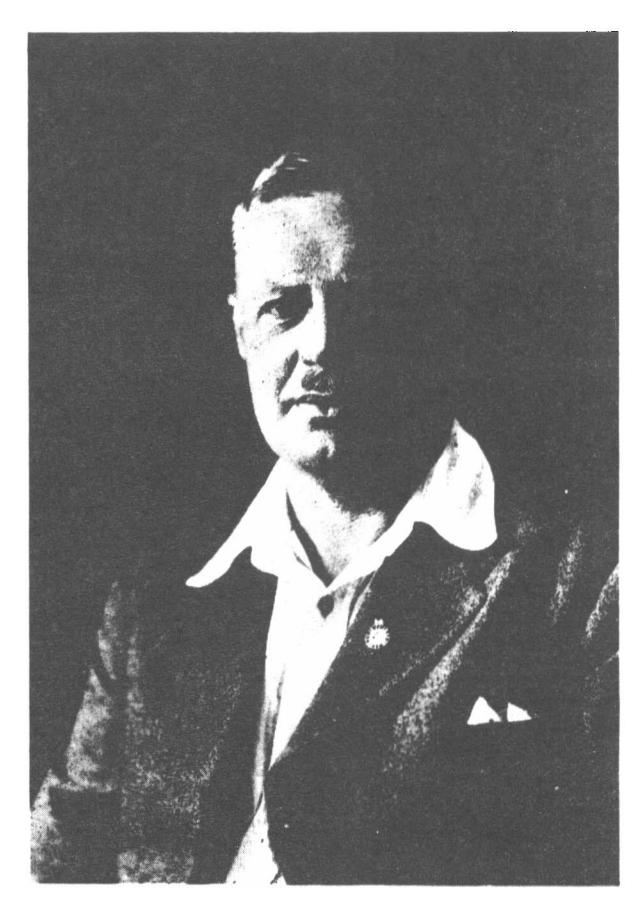
The Author.
BORN 1878 - DIED 1956

The Root of the Trouble.
Surely, everyone who attempts to write an autobiography should give his readers an adequate ancestral background against which to judge him.
Heredity always seemed to me to be a far more important factor in the basic character-formation of the individual than mere environment; it is one's forebears who hand down instinct, and what is instinct but hereditary memory born of fundamental experiences of past generations?
I have been able, thanks to the collaboration of many distant relations, to trace my ancestry through many generations. But, of the Leese family itself, I have no knowledge beyond that of a great-grandfather, Joseph Leese, of Richmond Hill, Bowdon, whose dates were 1783 to 1861: he married the daughter of a John Harrison, of Burton, and had a considerable family of which my grandfather, Joseph, was the youngest and the only son. I knew my grandfather when I was a boy and stood in great awe of him, although he was kindness itself: the rather formal interviews which I had with him seldom ended without a silver coin being passed by him into one of my pockets and no doubt my shy reaction amused him a lot. He had a grand head out of which many improvements in machinery for cotton-mills had developed, and he had owned mills in Preston. He was a Liberal in politics, but a Liberal of very different calibre to that of the ones I see when I look around me now. He married the daughter of "Honest John Scurr", a Brazil merchant, and well I remember this gentle old lady who never could do enough for her grandchildren. My father, Spencer Leese, was the eldest son of their numerous family.
The Leese family runs to a type which evidently has a strong prepotency: both sexes are generally tall, fair, blue-eyed, with heads broader than the typical Nordic average: any Mediterranean mixture by marriage soon seems to lose any trace; the general run of the family is of good intelligence with a strong sporting trend.
The Scurr family derived from one of William the Conqueror's Knights who was given Beeston Castle, near Morley, Leeds; that is the only claim I have on the aristocracy! But I amperhaps unreasonably proud of being distantly connected to
RICHARD OASTLER (1789-1861), the Factory King, the man who did the pioneering and rough street work in stopping the atrocious conditions under which child labour was then employed in the northern mills, a cause in which the Parliamentary activity was done by the Earl of Shaftesbury; Oastler's political enemies silenced him for a time by foreclosing on him for debt, and he was imprisoned in the Fleet for over three years; then his friends bought him out, and his return to Bradford was in the van of a procession a mile long. After his death, a bronze statue was erected in that town, with the simple inscription "Oastler", in which he is portrayed with two ragged children at his feet. Oastler was the grandson of the brother of my great-great-grandfather, Robert Scurr. I hope I may be excused for boasting such a slender relationship to so grand a man. Mr. Cecil Driver wrote a very fine biography of Oastler, naming it Tory Radical (Oxford University Press, New York, 1946).
My mother was daughter of Charles Hudson, Coroner of Stockport, and of a sound Unitarian stock of Lancashire and Cheshire. In the Unitarian community, I always found a high standard of citizenship and sense of public duty.
My uncle, Joseph Leese, was made a Baronet, having been Recorder of Manchester and Member of Parliament (Liberal) for Accrington; he and his brother, Ernest, played as amateurs in the Lancashire County Cricket Team and two of his sons were captains of the Winchester School cricket team. His grandson was Sir Oliver Leese, veteran of two world wars.
CHAPTER II.
A Slow Starter.
My father was an artist, but he had a modest independent income on which he reared a large family. As a young man, he was of immense muscular strength and I still possess copies of photographs of him "in the raw", the most striking of which is a back view showing a physique of broad sloping shoulders and narrow waist which reminds me of nothing so much as a section of the Cantilever Bridge across the Firth of Forth. He could lift, with one hand, a dumb-bell weighing 160 lbs. and raise it at arm's length above his head. I remember how, when the family removed from Southport after his death, my mother gave this relic away to a local circus. I never could lift the thing even off the floor with one hand; it just forced my fingers open if I tried. On several occasions, my father had accepted challenges by professional weight-lifters, and had beaten them, with lucky results for local hospitals. But with all this strength, of which I seldom really was forced to feel the weight myself, he was of the most gentle disposition and a good family man. In his early married life, he took a keen interest in horses and his honeymoon was spent in the Lakes where he drove his own very smart four-in-hand. Later, he owned the well-known harness cob Rattler which won many prizes at shows all over the country. But these horsey days were all before my time, as I was a late arrival in a very large family.
My mother was a very beautiful woman, a fact which I usually have to keep to myself, otherwise people are apt to crack the old joke, leaning forward, looking interestedly into my face to say: "Then it was your father who was not good-looking?" Her life was devoted entirely to the family and she taught us all to be civilised. Her eyes were blue and her hair was dark. I don't think any of us really knew what we owed to her until after she was dead. My parents lived in several places in the north, and before I was born there were already one son and five daughters. My eldest brother, Joe, was not a typical Leese; he was a strange mixture of scientist and musician and, as he was 13 years older than I was, we were never of much use to one another. Later in life, I found him so different in temperament and outlook to myself, that I decided the best policy to avoid a quarrel was to avoid him, which I did; and thank God, we never did quarrel. After him, every year or two
there came a sister, until five had appeared on the scene. Being thus so close together in age, they tended not to look outside the family for companionship and I believe they were very happy together. Then came a gap of four years and, at Lytham, in Lancashire, I was born in 1878. Four years later, we moved to Southport, where my early youth was spent. I was, perhaps, a lonely child and it is not an ideal condition for a small boy to have a large number of elder sisters and to be separated by more than four years from the youngest of them. I grew up in a very sheltered atmosphere, rather spoiled, selfish and with few attractive qualities as I can see them now! Remembering what I was myself as a child, I have never really been very fond of children ever since! I suppose I must have had redeeming features or all the others would not have always been so kind to me; but the only one I can recognise at this distance was a great and sympathetic love of animals which has been my joy throughout life. My first canine love was Gyp, a large white terrier and we grew up together. He wasn't really my dog, but my brother's: what Gyp didn't know about life in general wasn't really worth knowing; a wise dog, with a temper like an angel, and when his time came (a shattered leg) I knew tragedy. It has always been like that with me when my dogs have died.
I was sent first to a dame school, where I kicked a girl on the ankle and was "kept in" for an hour, bellowing the whole time: later to a boys' day-school which bored me stiff. Finally, I was sent to Giggleswick School, Settle, Yorkshire, in which I spent five years receiving an apology for an education, but at least losing some of the worst effects of a too sheltered life at home. My father died just before my last term, and the family fortunes declined with a bang. I remember quite well how, even in these early days, I felt that my time at this school was really being wasted and that I was growing up in an atmosphere remote from the realities of ordinary existence. I felt acutely my own want of experience, but had not then the initiative to take matters into my own hands.
My mother had to do the best she could; I was, myself, very slow to mature. It was unusual for a lad not to know the facts of life at the age of fifteen; I was a very innocent lad. Thinking it all for the best, she had me articled to a chartered accountant where I spent nearly three rather miserable years in the City. Then I woke up, decided that the totting up of the profits of others was not for me and, with the help of my dear old grandfather, overcame my mother's doubts and went into the Royal Veterinary College, Camden Town, to live my life with my beloved animals. I got scholarships three years out of the four, lifted thirteen first medals and spent my vacation with practising veterinary surgeons first as pupil, then as "improver" and, after that, as assistant. I had found my vocation, but had wasted three years. Well, perhaps they were not
altogether to be written off as a loss; at least I got a fine training in two things: firstly, in sticking out a monotonous job; secondly, rapid and accurate casting up of figures. Both these, especially the first, have been of great use to me in after-life. To think that I once passed the Intermediate Examination for Chartered Accountants with Honours!
Whilst I was at the accountants' office (M
About this time, I became aware of the fact that I had been suffering from astigmatism (with short sight) for many years. It is impossible now to make any estimate of the extent of this handicap; it meant that I had gone about without seeing a number of things which were within the range of normal sight, but beyond mine. However, I have much to thank my parents for in possessing a healthy body and an active brain. I had grown up well fed and had never known real hardship, and during my holidays had covered a large area of England and Wales; but I still felt that I had been sheltered too much and that I knew my country a great deal better than I knew my countrymen. However, from the time I began to go out "to see practice" in my vacations at the Veterinary College, I made up for lost time in that respect, because veterinary practice involves the treatment of owners as well as their animals! I always selected country practitioners with whom to serve, so as to obtain as much contact as possible with farm practice, and had many rough experiences which included concussion of the brain following a fall from a horse, with total obliteration from memory of about four days of my life. I also had the interesting experience of veterinary work with coal-pit ponies when I did "locum tenens" for a veterinary surgeon at Seaham Harbour; I used to descend the Seaham and Silksworth pits daily; each pit contained 400 ponies. They were, of course, shod cold, and there were more injuries than sickness.
I had a younger brother, John Scurr Leese, born ten years later than myself with no other children in between, my parents having increased the population over a period covering twenty-five years! He, of course, was even more isolated from the others than I had been; he grew up a typical Leese, broke the high-jump
record at his school and vanished for ever at Krithia, Gallipoli, where he was serving in the first World War as a private in the 6th Manchesters. When I look back, I realise that I hardly knew him: circumstances and difference in age prevented it.
the subjects, but I think that the bovine complacency with which John Bull allowed himself to be reduced to a second-class Power by engaging in a wholly unnecessary war in 1939 is partly explicable by these drug habits, which I think are superlatively silly.
CHAPTER III.
Into the Hard Cold World.
Although I had, during my college career, a large number of temporary spells of "independence" when working with veterinary surgeons in the vacations, the summer of 1903 brought my diploma and full professional status, and the first thing I did was to become an Assistant to a firm of Veterinary Surgeons, Messrs. Batt & Sons, of Oxford Street, London. In those days, there were few cars, and London's traffic—'bus, cab, commercial and private—was all horse-drawn. There were four qualified veterinary surgeons in the practice, two being the partners who owned it; the other Assistant at the time was the afterwards very well-known Veterinary Surgeon, Mr. Guy Sutton. We were kept busy all day long, driving all over West London to our equine patients. We were often called out to accidents in the streets and on such occasions I found it necessary to force my way through crowds of spectators, every one of whom, I gathered, knew what to do much better than I did. I became very expert at handling heavy and partly inert bodies, placing, roping, extending or folding the limbs so that the poor beast would rise under his own strength. This is a fine art which isn't taught in books and needs great strength, particularly when a horse has gone down in a narrow stall. In the street, there is more room; often when we found the animal could not rise from the side it was down on, we would turn it over on its back to the other side, when, with help it could generally rise to its feet. On one occasion, Sutton was beaten over the head with an umbrella by an angry old woman in the crowd who thought his well-meant efforts to assist his patient were superfluous.
I often wonder how the modern veterinary student can ever
become a good horse clinician in the absence of the huge equine population that gave us of the old school such experience. A good equine practitioner was rather like a specialised Sherlock Holmes, who could take in all sorts of observations whilst hardly knowing he did it, and come swiftly to a correct dianosis or prognosis. It was always the clinical work that interested me more than the scientific side; I liked to be with the animals and to study them so that no detail escaped me: veterinary patients seldom tell lies, but it takes close detective training to appreciate fully and quickly the meaning of their various signals of distress. I believe I was a good horse clinician; I was also strong on what I called "acrobatic surgery", which consisted of performing some slight surgical operation and springing out of reach before the animal had time to realise that anything had been done to him. I was only caught twice in my whole life: once when a horse kicked me just above the knee and once when a cow nearly tore my ear off with a hind foot. I always liked practice with dogs and cats, chiefly because I loved the animals themselves. Nowadays, a practice like Batt's then was, is simply unknown anywhere: so much have times changed!
After nearly a year of this, I was offered a much better job in the East End of London, managing a practice for a deceased veterinary surgeon's executors in West Ham, with a branch at Chingford, in Essex. This was worked with two horses and the long journey of seven miles between the two practices had to be done without any payment from clients. I was there for three years: there was a lot of night work, because I used to be night-man for many of Tillings' horses worked by Oil Companies at the East India docks. I remember how I used to cross Plaistow marsh in my trap at night with a twitch-stick handy at my side, for policemen went about in pairs in these parts. One of my ponies had been imported as a polo pony, but would not play; it was a grey mare and her peculiarity was a form of jibbing which was liable to take place if she was suddenly pulled up sharp for any cause, as behind waiting traffic at a crossroads. On these occasions, the pony would lose all control, backing for a number of yards, then rearing up and even coming over backwards which, of course, always smashed a shaft. After one or two such hair-raising adventures, I developed such tact in quietly pulling up behind traffic that she never gave me any more trouble; but I used to go away once a year for a holiday and whenever I came back, I found the "locum" had had one of these shaft-smashing experiences in spite of my warnings. Another thing which upset this pony and started a jibbing exhibition was my holding a conversation with some patient's owner by the side of the trap just before jumping in to drive off so I developed a system which cut all that out. Although this jibbing was a "vice" in the horsey sense of the word. I am convinced that it was nothing but "nerves". a
habit probably formed as the result of fright or ill-treatment when being broken in. Anyhow, tact eliminated it. The pony was so valuable in other ways that an occasional new shaft was a detail: you could not tire her, even with thirty-five miles, and in Walthamstow and Leyton, when coming back from Chingford, we often overtook and passed the electric trams of that day, and we must have been a remarkable sight "going hell for leather", with the trap full of dog-patients for our infirmary at West Ham.
In the East End of London, the chief event of life in some classes of the inhabitants seemed, to use an Irishism, to be one's funeral. Big Flemish black horses were imported for use in these: they came in as three-year-olds and went straight to their work at that age; they could stand it, because, of course, they never really did any hard work at all. Sometimes I had to examine these new purchases as to soundness and the only way to test their wind was to drive them up a long hill in a hearse! These animals are very soft-hearted in sickness; the same remark applies to the popular Percheron horse; these continental horses definitely have a different sort of courage as compared with our native breeds. As an equine clinician, I found this interesting; I do not understand why it should be, but I know that when I am dealing with a Flemish horse or a Percheron, I can discount certain signals of distress which would be sinister signs in a Shire. For instance, after a bout of colic, the foreign horses will anticipate another attack by betraying certain symptoms of pain when no pain exists and no further attack is coming, moreover. The equine practitioner can always tell these cases by a brief examination of the pulse. The English horse goes back to the manger soon after the pain leaves him, nuzzling about for food.
In those days, London used to have frightful dense yellow fogs in the winter. I well remember finding myself driving up the West Ham Free Library steps in one of these. Another time I was called out in a particularly dense fog to a horse which had fallen, waggon and all, into a tidal dyke in the West Ham Gas Works: his head was just above water and the tide was coming in. Quickly we lit flares on the banks of the dyke, so that we could see; the animal was freed of its harness in the icy cold water; a rope was passed in a fixed loop over the head so that the knot was under the jaw; two quiet horses were used for traction on this and out of the water and up the bank came our patient, still on his side and with his legs sticking out stiffly as though frozen. Brisk massage, a good dose of rum, and the usual manipulation of the body in such cases, got the animal to his feet and he was slowly walked home with three men on each side to keep him on his legs. He made a quick recovery . . . but probably would not have done if his value had exceeded ten pounds!

Plate 11. West Ham to Chingford Expres
I had brought away from West Ham a bull-terrier pup named Bill; he was destined to be my closest companion for several strange years and deserves a chapter to himself.
## CHAPTER IV.
# Bill of the Desert. Reprinted from "The Wide Wide World", February 1949, by kind permission.
Bill wouldn't have taken a prize at any serious dog-show. All the same, he could never have been mistaken for anything else but a bull-terrier. His mother was the most ferocious specimen of the breed that I have ever met with and was kept (usually on the chain) by a West Ham publican from whom Bill was purchased at two years' old for one pound sterling.
He grew into a formidable, but sweet-tempered dog, active and strong, with plenty of bone, well furnished with muscle. As from the first he lived with me day and night, he became—well, just what a dog of that sort naturally becomes to a man who had yet no other love.
The first year of his life was really uneventful, except that when we moved from West Ham to Vauxhall, he broke out next morning and disappeared. He came back in the evening; but we found he had actually been as far as Waterloo Bridge, all through a busy part of London entirely strange to him, so it was clear that he wasn't a dog that would easily get lost!
After two months of Vauxhall, I went out East to investigate camel diseases for the Indian Government and, of course, Bill came, too. We went out in the hot weather, an unusual season in which to send newcomers out to India and our ship was almost empty of passengers. Bill travelled in a special kennel on the poop, and the Captain allowed me to exercise him on the well-deck. Bill was keenly interested in the North African coast and was never sea-sick, even when the Monsoon, in the Indian Ocean, sent spray and even at times a wave over his kennel. In the Red Sea, we had the uncommon sea-experience of a flight of locusts over the ship, and their pink bodies hopping about the deck were a source of great excitement to Bill, who killed and ate a large number.
There followed a punishing train journey from Bombay to Lahore in June, and then I was sent straight up into the hills for a preliminary study. On my arrival in the Himalayas, and knowing nothing of the ways of natives, I got a sweeper to wash Bill clean

Plate III. (1) Bill

........................................
Here I was calmly informed that dogs were not allowed in our living quarters to which I replied, with some heat, that I had not come from civilisation to mid-Asia to be separated from my dog, and the matter dropped.
Soon after, I got carte blanche to get on with my job, so down we went into the plains, which we rarely left again. My work was field research in the most empty parts of North-West India and I had to get particularly busy at the worst season of the year, when luckier men could go into the hills. We travelled almost constantly, my mounts being horse or camel according to the nature of jungle or desert through which we were passing. Bill, now in vigorous health, travelled on his sturdy limbs, accompanying the baggage-camels that move at $2\frac{1}{2}$ miles per hour. When possible, to avoid the heat, we moved at night and in the early morning. It was a hard life with brief intervals of comparative comfort when we reached a rest-house.
Bill and I suffered about equally from the dry heat, but it was he who rushed out into the first downpour of the Monsoon, racing and splashing through the puddles uttering squeaks of joy in the sensation of being cool at last.
Bill's travelling life was full of incident. One nuisance was experienced in the habits of pariah dogs. These ownerless curs, of all sizes, have regular beats like policemen in the villages they infest. No stranger dog can encroach upon another pariah's beat, which usually provides offal for the bare existence of one dog only. If a stranger dog is sighted, the pariahs of a village unite to liquidate him. Thus, when Bill, rolling along by the side of the baggage-camels, with tongue lolling, approached a village, one might see converging upon him a number of streaks of dust, indicating the rapid advent and onslaught of the pariahs of the place. Bill hardly ever started a fight, but was good at finishing one. Not for Bill the tactics of the pariah and the wolf—slash and break away! Singling out the most formidable opponent, he took hold and stayed where held, using his weight as perhaps his mother had taught him.
His tactics defeated dogs twice his size, like the big Pathan sheep-dogs of the North-West Frontier. It was the *foot* of his opponent to which he attached himself as soon as he could. Then he would worry and pull away with his compact weight so that his antagonist could never close with him. It was wicked to see, but it is passing strange how he learned this trick; did he discover it by accident, or did he think it out? Occasionally, when he had a number of opponents, he got badly gashed, and I was always on my guard for the first signs of Rabies which happily never arrived.
Sometimes, when we crossed rivers, I would take Bill up on the saddle with me, but more often he swam them himself after we had crossed.
Bill was a fearless, but tactful guard. The presence of Bill in my tent allowed me to sleep soundly in lonely places along the North-West Frontier which he and I travelled from Shabkadar to Dera Ghazi Khan.
Once he was lost in the desert. I had gone ahead on a riding-camel and arrived at a well (our destination) several hours before the baggage-camels with which were my servants in charge of Bill. My bearer, greatly agitated, reported that Bill had disappeared ten miles back where there was thick scrub in the desert: "chasing a pig," he said. It looked black for Bill. Fortunately, I had a good map; after considering the position, I found there were two other wells within twenty miles from the approximate place where Bill had gone off. With a sinking heart, but somehow banking on the dog's intelligence and instinct in making for water, I sent a camelman to each of those wells with instructions to wait all night and start back at 9 a.m. to report. In those parts, a dog lost for 24 hours is a dog lost for ever. But, sure enough, next day one of the men returned leading his camel with one hand, and a weary, hungry Bill with the other. Somehow, he had found his way to the water. Ours was a rapturous meeting.
Bill's relations with camels were always friendly, though sometimes wanting in delicacy. On rare occasions, at the eastern end of our immense "beat", he met with elephants; unfamiliarity with these monsters made him aggressive and noisy, so, as he was quite without fear, it was considered a wise prophylactic measure to remove him as early as possible from their vicinity.
My bearer had a monkey; a quaint fellow who would jump from any reasonable height, say, the top of a bungalow, into my arms where he liked to sit, peering expectantly, from time to time, up my nostrils. Sometimes, after I had been cooling myself in the bath-tub, the monkey would take my place, swimming round and round under water and coming up occasionally to breathe. When
In that half-wild life, even Bill's dinner wasn't always safe. Once he was discussing a bone in front of the tent, but had not observed the presence of two crows in a tree close by. One of these alighted a yard in front of Bill's nose, inviting inevitable attack, which Bill at once jumped forward to make, dropping his bone. In a flash, Crow No. 2 swooped on the bone, and the two cunning villains went off to share it together. One could not help admiring them for their sporting co-operation, so exquisitely timed.
Mahomedans are taught by their religion to regard dogs as unclean animals. However, my chief Veterinary Assistant, Ata Mahomed, a devout Mussalman and a kindly and observant lover of animals, saw something in Bill that wasn't written in the Koran. He loved him and would sometimes squat on the verandah with his arm round him, talking to him.
After about two years of this sort of life, I woke up one night with a start, feeling something was wrong. It was. Bill was not on the bed. I lit the lantern and found him under the bed, hardly conscious; he died five minutes later. I expect it was valvular trouble, a legacy of the rheumatic fever. He took a bit of me with him, I think. It was Ata Mahomed who arranged his burial, and even photographed it for me to see afterwards; it was Ata Mahomed who had a grave dug which was so engineered with stones that the most clever jackal could never penetrate it. There we left Bill of the Desert with a stone to mark the place—"for ever England"—where his bones certainly still lie.
And I went on, alone.
## CHAPTER V.
## Six Years of India.
Then I was sent to Kathgodam, at the foot of the hills below Naini Tal, to study Surra which affected the tonga (fast horse transport) service between the two places named. This was in early October and I was not long in making my first discovery of importance. It was known that the big horse-flies called Tabanus were capable of transmitting the disease from one animal to another, and part of my job was to make a fly-survey of the road. The instructions I had been given were that the disease was spread only at one season of the year, namely October to December. I soon found, however, that any ponies infected with Surra at this time had been ill for weeks and even months and that no fresh cases were now appearing; I found, too, that Tabanus was conspicuous by its absence, whilst the other common biting-fly, Stomoxys, which was also under suspicion, was still very prevalent. My conclusion was that I was starting work too late in the season, and I reported to my seniors that I thought it would be found that it was in July, August and September that the disease was spread, and that investigation would probably show that this season, not the later one, would coincide with the presence of large numbers of Tabanus flies. This was later proved to be the case and, of course, revolutionised the whole of the routine preventive measures. I also showed that in spite of its prevalence, the biting-fly, Stomoxys, had not apparently been able to maintain the plague beyond the Tabanus season which was much the shorter.
After a brief stay in the Muktesar Imperial Laboratory, magnificently situated 7,500 feet above sea-level right opposite the first great wall formed by the mass of the Himalayan mountains, I


Plate IV. (2) On the Bridge of the Ship of the Desert.
left for the Punjab plains to work at first with the eight Silledar Camel Corps which were distributed all over the province. Whilst working there in the jungle I got my first bout of malaria. My experience with this complaint was short and swift; I took 30 grains of Quinine immediately, and continued until I deafened myself with the drug; then I stopped. It is a fact that from that day to this I never had another attack of malarial fever, in spite of unavoidable and frequent exposure to the Anopheles mosquito during the next eight years. Whether the malarial organism is particularly vulnerable to Quinine at its very first onset, I do not know, but it certainly seems like it.
Postmortem work on camels which had died from unrecognised causes was, of course, a fruitful source of information, but there were great practical difficulties to be overcome, and sometimes when an outbreak of some camel-disease had occurred, I would travel even hundreds of miles (by rail and in the saddle) to arrive at the scene before the fierce sun had made conditions impossible. Often, after we had finished an autopsy, we would look round to find seemingly the whole population of North-West India's vultures in a circle of which we were the centre, waiting on the ground for us to leave the carcase to them. When they got to work, one could not see the carcase for vultures and often in the midst of them, tearing away at the meat for dear life, would be a number of pariah dogs; neither vulture nor dog seemed to have any animosity towards one another. Sometimes, rather than lose a chance of discovering something by a postmortem, we would tackle it far from a water-supply and that was grisly work.
I soon took a dislike to the social conventions which ruled station life in India, but as all my work was in the jungle and desert, I rarely stayed more than a couple of nights in a city, staying just long enough to take in a fresh stock of stores for another long trip in the "out back". Travelling was by horse or camel, and I soon reduced my baggage to a minimum which surprised some of the other officers I met on tour. I had two assistants, graduates of the Lahore Veterinary College: one of these was a Mahommedan, Ata Mahommed, the other a Sikh, Kahan Singh; they were splendid workers, with their hearts in the business at hand. Ata Mahommed, particularly, was a most determined character who resolutely refused to let our difficulties beat us. I was lucky also in my servant, a Mahommedan who stuck to me throughout my six years in the country; and he certainly saw a great deal of it during the time. I was very happy in my relations with my superior officer, the Inspector-General of the Civil Veterinary Department, and I had the advantage of being an Imperial and not a Provincial official. Colonel Pease (for that was his name) never said "No" to me once he was satisfied that I meant business: I used to propose to him what I thought the next step should be and he would just say "Carry on". This was lucky, as I have always been impatient of discipline. It is often said that unless you can stand discipline yourself, you can't discipline others; I do not believe a word of it! I am not speaking of army and navy service, of course, but I am sure it is not true in the rough life of the pioneer.
I arranged that the next Surra season should be spent in a known zone of the disease and that the principal work should be done with the use of ponies; ultimately the road from Saharanpur to Dehra Dun was chosen and I secured the use of a forest bungalow at Mohand, just where the highway entered the Siwalik hills. This place was known to be pretty certain death for tonga-ponies at that season. I arrived some time before the monsoon would bring out the flies, partly so that I could make a proper comparison between the fly conditions in the dry heat and those in the damp, but partly so that I could buy some ponies, build a stable and prepare mosquito nets on a large scale to protect certain of the ponies. We took several camels with us, which had chronic Surra; this to make sure that a source of infection would be present; and we had a number of white rats and white mice on which to investigate the various kinds of biting-flies' transmitting powers. As the place was very malarial, being surrounded by thick jungle full of all sorts of wild beasts, including elephant and tiger, I arranged a bamboo cubicle which, when covered with mosquito netting, enabled me to have my meals and evenings in peace. I did no shooting: I dislike killing animals except for food, and my business there was to do work. I used to keep fit by long walks with my bull-terrier companion.
Everything pertaining to the proper management of the camel, his breeding and feeding, down to the identity and seasonal value of the bushes he grazed upon, was my business. In the first few Surra seasons, I was travelling light through the monsoon in the steaming plains when men who considered themselves luckier were recuperating in the hills. I had to cover as much ground as possible so as to detect the different areas which were reasonably safe from Tabanus so that Camel Corps men could use them for grazing their animals in the Surra season. This work took me very far afield and there are few of the desert areas in North India that I am not familiar with. But whilst doing this work and everything else which cropped up, I noticed that the areas most infested with this fly were characterised by the presence or predominance of certain species of vegetation, which seemed to require for their development the same conditions of heat and moisture as the fly. This enabled me to use winter months in which to detect the worst Surra zones: this was done by checking up the grazing bushes, trees and plants which associated themselves with Tabanus country; one could thus detect in the winter season an area which, in the rains, would be a Surra zone. Meanwhile, the practicability of specific curative treatment of camels with trypanosomiasis had to be investigated and this work required some sort of headquarters. I established the centre first at Sohawa, just north of the Salt Range, in the Punjab; it was not a Surra zone; it was on the railway and Grand Trunk Road, and so was handy for communications and a sufficiency of camel-grazing was available. But for several years we could not get the Government to build suitable quarters for this
centre and I had to live in tents until, at last, they did. It was known at this time that certain arsenical drugs were capable of banishing the trypanosomes from the blood of animals, although after a few days' absence they would return: in some species of animal there had been occasional cures. With such drugs as were then available, it was almost a case of finding out how much and by what method the trypanosome could be finally killed without damaging the animal patient. This monotonous work, however, was tackled and in 1910, by a farly long treatment, we had 50 per cent cured by certain treatments; similar results were being obtained in Egypt. These treatments were gradually improved upon until by some methods majority cures could be obtained, and after I left India the methods were developed until one could rely on a 90 per cent. cure. Meanwhile, in the laboratories of Europe, organic drea compounds were being investigated and ultimately one was found, called "Naganol", which, in suitable dose, will give 100 per cent. cures of uncomplicated cases in the camel. The whole problem of Surra in the camel has been revolutionised by means of this easy and certain cure. In the early days of my work at Sohawa, there was no recognised length of time after treatment at which an animal could be pronounced certainly cured, so we had to examine our camels' blood daily for periods up to one year before we could properly announce our first successes.
Needless to say, when I became entitled to some leave, I was very ready for it. By this time, I had decided that I would not stay in India for a pension; Indianisation of the services was obviously coming, and I had no time for that. Having no ties at home, it seemed a good opportunity to see something of Australia, so I spent this three months' leave in the sophisticated parts of Victoria and New South Wales. On this trip, I did not go "out back" as I had had my fill of that in India and wanted a change; I gave two lectures on the Camel at the Melbourne Veterinary College; otherwise, I just "enjoyed myself". My second leave was taken just before I gave notice to the Government of India that I had decided to leave its service. This was also spent in Australasia and, during it, I travelled right into the heart of Western Australia and also as far as Port Augusta in South Australia, to see for myself the conditions under which camels lived and worked there. I had thought of taking up land in the back-blocks and breeding camels there when I had finished with India; but I decided that the future of gold-mining was too precarious for such a long-term venture. On this trip I also visited New Zealand, chiefly for sight-seeing, and had a grand time in that exciting country; I worked down from Auckland through the volcanic districts to the Wanganui River and Wellington: then, in the South Island, I went to Christchurch and contacted the Government Veterinary Surgeons there to my

great professional advantage; I left New Zealand at Invergordon, regretting that I had not enough time to go over the passes to Milford Sound. Thence I went to Tasmania, and through that island back to Melbourne and to India. Soon after arrival in Sohawa, I gave my three months' notice and, in due course, in February, 1912, I left for home, from which I had been absent six years.
The Indian Government had been ready to employ me in investigation work on elephants, a job which I might have found attractive had I been fresh from some temperate climate. But I felt that it would be difficult to become expert on such a subject unless I could live on the job for at least three hundred years, and as this wasn't likely, and I had no desire to leave a job on which I really was expert to take on one at which I could not see how an ordinary lifetime could provide enough experience to get one out of an amateur status, I decided I would stick to camels. I foresaw intense interest in comparing the camel conditions in other countries with those of India. On the way home, I stayed two weeks in Egypt, sight-seeing and looking for jobs; two of the latter were available, but they were not what I wanted, and I went on home to see the family once more.
## CHAPTER VI.
## On the Equator.
When in India, I had saved most of my pay and so now I had enough income for bare subsistence, which gave me the independent feeling which was so important an item in what I regarded as a happy existence. I had been used to sending my money home, from time to time, for my Uncle Ernest, who was a stockbroker, to invest for me, which he did with good judgment. I told him that what I wanted was a small safe regular income so that, if necessary, I could say boo to a goose. I was in excellent health and, of course, a master of my job. After looking about for two months or so, I joined the Veterinary Department of the East Africa (now called Kenya) Government in a specialist capacity as Camel Officer. It was intended that I should make my headquarters at a place called Marsabit, which was an extinct volcano on the corner of one of the big Game Reserves, about 2,000 feet high and 200 miles from anywhere. There I was to establish, in addition to my camel work, a station for testing imported Abyssinian ponies for glanders.
However, God disposes and things turned out differently. When I arrived at Nairobi, the capital, I found that ivory poachers from Abyssinia had murdered a District Commissioner not far from Marsabit, and the Government did not regard that place as safe for me to use as intended. I was side-tracked to Jubaland instead, which is the desert country west of the River Juba which comes down from Abyssinia and flows into the Indian Ocean ten miles north of Kismayu. To get there, I had to go down from Nairobi to Mombasa and take a small coasting vessel.
Jubaland is truly Godforsaken, and the equator itself runs through it close to the mouth of the River. It is hot at all seasons and low-lying; it is malarial wherever desert conditions do not obtain. Most of it is desert, but the track to the north is never far from the river. It was no place for a white woman. Up-country life had to be lived in ramshackle wooden huts, and the only produce of the desert was livestock. On the other hand, there was game in plenty and on tour one shot one's own meat-supply. The menu
could be dik-dik (a small antelope about the size of a whippet), guineafowl, junglefowl, bustard, partridge, duck (where there were lakes from the river-overflow in the rains), and sandgrouse, which could be got at 6 a.m. by waiting at any waterhole at that time. Owing to the prevalence of the acacia known as the "wait-a-bit" thorn, through which it was impossible to force oneself without having one's few clothes ripped off, it was not good stalking country and it was only seldom that the bigger game, such as gerenuk, lesser kudu and oryx could be bagged. Lion abounded and were often heard grunting around the thorn-bush camp protection (sariba) at night. Stores had to be well calculated, for nothing of that sort could be obtained up-country. The Somali population away from the river was all nomad and the only villages, often inhabited by the descendants of run-away slaves, were by the riverbank. Mails were slow and scarce, coming by native runner (if one lived at Serenli) 200 miles as the crow flies.
\*\*\*\*\*\*\*\*\*\*\*\*\*\*\*\*\*\*\*\*\*\*\*\*\*\*\*\*\*\*\*\*\*\*\*\*\*\*
On one occasion I was travelling up the right bank of the Juba river when I got lost in the bush. I was walking about a quarter of a mile ahead of the baggage-camel convoy and just after sunrise. I had shot some game for the day's food, and left the victims in the middle of the track for the first camelman to pick up and load on to his animal. How on earth I got off the track I do not know, except that it was only the width of a camel's foot, but suddenly I found the sun on my left front instead of where it ought to have been, definitely on my right. I must have turned an almost complete circle. I felt the panic that seems to affect all men lost in the bush, but instead of running about wildly as the urge was, I said to myself: "Sit down, you fool!" and did so, on a stone, until the panic passed. Then it was only a matter of simple calculation which direction to take to get to the river. It was 6.15 a.m. and we were practically on the Equator and I knew I was on the right bank of the Juba. The Juba flows roughly North to South, although with many bends. It was clear that all I had to do was to walk straight into the sun. I remember seriously arguing with myself as to whether the sun really rose in the East! You see, perhaps my life depended on making no mistake! Then I got up and struck out across the scrub with the sun in my face; before long, I detected a downward slant in the desert ahead, and soon got to the river. I found the tracks of the ration-goats which had been driven along behind the convoy and having had a drink in the track and got into camp just before a search-party was starting out to look for me.
I spent several months at a forsaken spot called Serenli, 400 miles from the coast when you travelled on the river, and joined the expedition of Brigadier-General Hoskins when he went right on into the Marehan country to try and talk the natives there out of the necessity for a military expedition to make them behave. Whilst Hoskins did the talking, I was quietly surveying the routes for the future expedition if it were found unavoidable. Thus, the expedition could take place with the minimum camel-loss from Surra.
However, Hoskins made no great impression upon the Mare-
han, and the expedition was decided upon. I was sent right down to the coast where I had to arrange the landing on an open beach, at Kismayu, of 350 camels of an Indian Camel Corps which was to take part. The Commanding Officer, the Native Officers and many of the men in this Camel Corps had known me well in India and were astonised to see me coming up the side of the ship in Kismayu harbour. We had to sling the camels from the hold of the ship into flat-bottomed river steamers which, when full of animals, were taken inshore and then the camels were slung out of these into the sea and had to swim the last bit. Kismayu harbour, although almost on the equator, is entirely free of sharks owing to its very narrow entrance through a gap in the coral-reef which closes it; and it was quite good fun taking headers into the luke-warm sea from the decks of these boats to try and get a little respite from the intense heat. Once landed, the camels had to be acclimatised to the strange new grazing plants of the country, but only three weeks was available for this and when the expedition moved off upcountry, some of the animals had only just recovered from diarrhoea and indigestion due to the change in their diet.
I had a row with the Government at this time, having received peremptory orders from my Chief to join the expedition as Veterinary Officer. My status being Civilian, with no provision for the possibility of my becoming a casualty, nor any definition of my rank in a Military Expedition, nor any certainty of my status as to discipline, I refused this order unless it was first agreed on all sides that I was a civilian and nothing but a civilian and would take no orders from anyone as to my work, but only as to my movements. There was a lot of bobbery about this, but I got my way; I was always anxious to accompany the expedition because of my friends from India taking part in it, but I had no intention of being ordered into duties which rightly belonged to the Army Veterinary Corps, and that without proper serious consultation. I took the long convoy through the tse-tse country, and all camps, marches and arrangements for watering the camels at places infested by fly were carried out according to my advice. On arrival at Serenli, I was thanked by the Officer Commanding for "playing the game", but I often wondered what other game he thought I might have played! Some weeks later I returned to the coast, half the journey being performed by river, in a native canoe; I was accompanied by a British Officer who had "gone funny in the head" and the long journey wasn't easy on that account. After a few days, I was returning with a big convoy of camels with supplies for the troops upcountry. But the long marches had told upon me; I had had sciatica very badly from overmarching before I left Serenli for the last time and I had also suffered from inflammation of the outer passage of the ears due to using, for washing purposes, the only water available
On landing at Mombasa, I accepted a commission as Captain in the East Africa Veterinary Corps on the understanding that I was to be allowed to resign in the event of the camels being dispensed with. I suspected we were going straight into tse-tse country, where they could hardly serve for long with success and I had no intention of placing myself under military discipline for long under a man I detested. The only military uniform I had was a hastily cut red band around my solar topee, an E.A.V.C. badge and a captain's stars; the rest of my apparel was civilian khaki. I found tse-tse wherever we went and the camels hardly earned their keep by patrolling in thick bush country where they were such conspicuous targets for a machine-gunner. They began to sicken with Ngana, the form a Trypanosomiasis which is carried by the tse-tse and I did my best to treat them with the clumsy methods then known. We lost very few of them, but I notified the Commanding Officer that he would certainly ultimately lose the lot if they were not

Plate VI. Author joins up in World War I
removed from the tse-tse country, where they really had no business to be. After two months' service in the Serengetti "desert" (not really desert as we camelmen knew deserts) I received instructions to take the camels back to Jubaland. This I did, returning on the same ship and demanding my release according to the agreement made. After some humming and hawing, I received my discharge, and took the first available ship, a French one, to Marseilles. On the way, I wirelessed the Egyptian Government offering to disembark in Egypt for war service there, but got no reply.
## CHAPTER VII.
## The First Great Slaughter.
After a few weeks, we moved off, one night, down to the neighbourhood of Bethune, and the following day we heard that our last position had been laid flat by shelling. Here we stayed a long time; the batteries were, of course, up nearer the line; ammunition was very short at this time and our heavy horses were sometimes called upon, in pairs, to take up four rounds at a fast trot, which did them no good. At this place I remember seeing the
(then) Prince of Wales marching with his regiment; and the Canadians would come down from the fighting line bringing their customary one white-faced prisoner to show where they had been. I had a lot of Units to vet at this time, and my professional rounds took me over a lot of ground. I spent Christmas Eve in the trenches with the Officers of one of our Batteries at Annequin and it was from an observer's post that I first saw the Germans with whom we were at war.
Veterinary work at the front in war-time is not very satisfying to the clinician, because prevention is his job, and he has to send all trouble to the rear to be dealt with by others. Detection of trouble at an early stage is the chief duty, but I used to treat some cases myself if I thought the delay in sending them back would prejudice their recovery.
Our Medical Officer at that time was a Harley Street specialist and I had to sympathise with him when he told me how he had, as a Lieutenant, to sit back and say nothing when some young and inexperienced man who was his senior in rank was botching a job or doing the wrong thing. We "temporary blighters" had our trials!
After one year of service, I got leave and went home to be married. On my return to France, I found I was posted to a Veterinary Hospital at Abbeville under Major Hobday, who was, in civil life, Chief of the Camden Town Veterinary College and whom I knew well. I was second-in-command. Here, nine months were spent and I became the operating surgeon for major jobs which were done under chloroform and although this work is not really my bent, I was trained by the Major, who was a specialist in these major operations, until I could be trusted to do them alone. Very few veterinary surgeons have had such an opportunity: the general run of the work was in removing the testicles of cryptorchids or "rigs" in those abnormal cases where one testicle had been retained in the abdomen; spaying vicious mares; the "roaring" operation; removal of the lateral cartilage of the foot in "quittor" cases; removing deeply situated shell splinters or shrapnel bullets; and the radical operation for "poll evil". There was a lot of general practice, too, which was what I loved, with diagnosis of lameness (which is a fine-art), whilst frequently we had to use the mallein test for glanders in preventive work; this test was done by injecting the mallein into the horse's eyelid, and with proper organisation one could do 100 in an hour.
During my long stay in this Hospital, I was skilful enough to evade every Church Parade; there was always a sick horse to be attended to, just at the right moment! I always felt that Church Christianity was quite incredible; I am the son of a Unitarian mother and I believe that different races require different religions.
I was instructed to proceed to Hargeisa, not far from the Abyssinian border, and buy camels there. I had with me an Arab interpreter whose loyalty I had reason to doubt. At Hargeisa, I
found that no camels were coming in for purchase, so I called a meeting of akhils or headmen. Sitting on a chair, I told these people to gather around in a semi-circle so that they could hear the King's Message. I explained the need for camels in the war against the Turks in Palestine and drew, with a stick, a rough map in the sand which, of course, they only half understood, showing how the different camel-countries had contributed camels for the campaign. I marked Somaliland in this map as a very insignificant country. I told them that the King had called me to him and had asked me where he could get more camels and that I had replied "In Somaliland". "Where is that?" said the King. I told him, and asked him what to do if the Somalis would not sell? His reply (as I invented it) was "Tell them that I am training many young soldiers at home and that I want to accustom them to the sight of blood".
That ended the "ring". From that moment, I was able to buy an average of 30 good camels a day for over three months; occasionally a feeble attempt was made to form a fresh "ring" to send up the price, but I broke these by saying I was well paid for my job and the longer they delayed me in selling their camels, the longer I should be away from the carnage in Europe. In the East, it is safe to appeal to the baser instincts of man. I bought 3,500 animals at Hargeisa and Mandera, whilst the other three officers had collected 1.500 between them. Towards the end of the time, Major Herring-Cooper returned to Egypt and I was left in command, although one of the other Veterinary Officers was a regular and my senior by service. We had an extremely useful Australian officer sent to us called Hayward, whom I put in charge of the camel concentration camp some miles out of Berbera.
By the time the last transport arrived to take us up the Red Sea, we had just about combed Somaliland of all the camels it could spare. In loading up the camels at Berbera, I got a touch of the sun and was in a poor state during the voyage; when I got to Suez, I was sent straight to hospital where my blood was frequently examined for malaria although nothing was ever found. Thence I was transferred to Alexandria, where I recuperated in an Officers' hospital and was completely forgotten by the authorities and I daresay I could have stayed there throughout the war if I had so desired! The only incident worth recording here was the arrival of a man suffering from exhaustion and exposure from being torpedoed in the Aegean. His discription of his experiences has always stayed in my mind; when the torpedo struck the ship, he was in his cabin; he just had time to run up to the deck and jump over the side as ordered. But the ship was carrying mules and, as she went down, some of these got loose and into the water. Remember it was at
night. The instinct of mules in the direction of self-preservation is very strong; when suddenly dumped into deep water, they will try and climb upon anything that is afloat. There was not much afloat except men, so the mules tried to climb on them! My narrator said: "The night was dark and yet the water seemed to be all ears and teeth". A vivid description! Yet he went on, with tears in his eyes, "When a destroyer at last picked me up, one fellow rode up to the ladder on a swimming mule and when we moved off several mules were streaking after us trying to catch us up."
War is a beastly thing for animals as well as men.
When I felt like it, I reported my hitherto forgotten presence, and was told to join a transport for Marseilles, which I did, the only adventure on the journey being the appearance of a submarine, upon which our two escorting destroyers quickly enclosed us in a smoke-screen within which we changed our course and took temporary refuge in the bay where St. Paul was said to have been wrecked in Malta.
On returning to Abbeville, I applied for a spot of leave, but I was not one of the General's "grey-haired boys" and was directed to take up special duty at Brest, where my job was to prevent the Portuguese Army, which was landing there, from bringing in useless animals or contagious equine diseases, particularly glanders. For some reason, I was not allowed to test them with Mallein and could only stop "open" cases. My London experiences had familiarised me with glanders in its many different aspects, which was perhaps lucky for many people, because the disease had been stamped out of Britain in recent years and the new veterinary graduates were not accustomed to it. Owing to the fact that only one ship was then employed in transporting horses from Lisbon, this was a very soft job for me and I discovered that officers could get permission for their wives to join them if they wished; I did wish, and met mine at St. Malo and we spent a very happy time together, at Brest, for six or seven months. The town of Brest was then full of American, Portuguese, and even Russian soldiers, but I never could understand why the Portuguese were ever used.
were after him not to frighten or hustle him, and I got close to the spot where he would land, for he was looking down, snorting and fidgetting for a foot-hold. The height was about 25 feet, but the landing was grassy and favourable. Then he jumped, and what interested me was to see quite plainly that although a horse taking an ordinary jump lands on his forelegs, this fellow, jumping from a great height, dropped his hind-quarters whilst in the air so that he landed on his hindfeet, thus breaking the shock. He was quite unhurt.
When this duty was done, I got leave and my wife and I went home together.
On my return to France, I was posted as Veterinary Officer to the Advanced Horse Transport Depot which was situated just outside Abbeville. Here, there was a floating population of horses and mules varying from about 3,000 to 7,000 and my time was well filled. I was engaged in this unit until I got my discharge at the end of the war. One night, the depot suffered an intense bombing, 320 horses being hit, of which about 180 were killed outright or had to be slaughtered. I was on continuous duty for 48 hours; in some sections, the dead horses were piled one on top of the other to the height of one's shoulders; perhaps the ones at the bottom of the heap were still breathing, some with their legs blown right off. I had to get at them how I could, and my revolver got almost too hot to hold. One poor fellow, I remember, had both hind legs blown of at the hock and was standing on the stumps, looking like a bewildered rocking-horse; I could not get his head down for the usual brain shot, and I shot him just in front of the ear and leapt quickly to one side as he came crashing down dead, nearly on top of me. All that first night I was doing this grisly work, shooting the hopeless cases and extricating the others. All next day I was doing first-aid on the wounded ones, getting the milder cases off on the one-mile march to hospital before they had time to get too stiff to move off under their own power, and loading the worst cases into ambulances. Right into the second night I was still extracting splinters from wounded horses where the missiles had not penetrated deeply enough to require special facilities for their removal. I knew the beastliness of war, that night.
The officers of the Unit itself were Royal Army Service Corps men, all selected for their jobs because of familiarity with horses, and they were very pleasant people for a veterinary surgeon to work with. On slack afternoons, which were rare, we would have an imaginary fox-hunt over the downs around Abbeville, with an imaginary fox and imaginary hounds. The purpose of the unit was to replace casualties from the front, our horses being conditioned, trained and paired as requisite, ready for supply.
One day, a bright young red-hat from the Veterinary Staff came over to inspect my work. He asked me whether I saw to it that crushed oats were used so that the horses could get the most benefit from their corn. I said: "No, Sir" and he waxed eloquent on my oversight. When he had finished his tirade, I said, "Excuse me, Sir, but no horse leaves this depot unless he himself carries in his mouth the most efficient corn-crushing armament; trained men inspect every animal's grinders and if there is anything wrong with them, it is at once put right; further, if you will excuse me, Sir, these animals will not get crushed oats at the front and if they got used to eating them here, they would fall away quickly when they got up to the front where their work was hard and the corn fed whole." After that, I was left alone to do my job without interference.
There was a tense moment when the huge unit, which had been for years at Abbeville, got orders to get ready to move to the coast at two hours' notice. The Germans were in Rouen! However, the order was cancelled and we never moved at all as long as the war lasted.
### CHAPTER VIII.
Camels: Fiction and Fact.
Reprinted from "Country Life", 13th April, 1945, by kind
permission of the proprietors.
Nearly every popular tradition about camels is without factual basis and how many fables there are concerning the strange specialised animal met, in this country, only in zoos and menageries! If it were not for our native mud, he might have been a familiar domesticated worker here, provided he received stabling in the winter and reasonable protection from flies in the Summer, but even then some tall stories might have survived, because there are people who still believe that the horses's eyes magnify what they see, and that that is the reason he submits to Man! The horse is protected from flies by a special muscle attached to the skin itself which shakes them off and by his naturally long tail. The camel has no such defences and soon becomes exhausted by the muscular effort needed to beat off swarms of flies. That is one reason why the camel lives in dry climates.
Exaggerated notions exist of the camel's capacity to resist thirst; it is great, but the camel, even if he doesn't look it, is, after all, flesh and blood. There are certain antelopes which exist throughout the year without access to spring or river water, but they don't have to do work under those conditions. The working camel always thrives best when he can drink as often as he wishes, but if the necessity arises, he can keep going and remain fit on intervals between drinks of two to five days, according to the breed of camel. He can endure and survive privation of water for a much longer period, but will then suffer and will need plenty of time for recuperation.
Perhaps the tallest of travellers' varns about the camel is the
one which alleges that when lost in the desert and in danger of dying of thirst, a man may find relief by killing his camel and finding the bag of water which he is supposed to carry in his stomach. It would be much better to spend the time and energy in trying to find water somewhere else. There is no such supply maintained in the stomach; there is an excess of mucus in parts of the first stomach, but to suck some of that would act as an emetic and you would lose more water than you gained. The camel's specialised apparatus against thirst consists of an excess of mucus-secreting surface in the throat and in the first stomach, which enables him to moisten his food in chewing the cud, even if he hasn't had a drink for a week or so.
The camel's hump is a store of superfluous fat which is drawn upon when food is scarce; it is relatively bigger and more efficient than the hump of the Zebu ox, or the "spread" of a middle-aged man which may be a similar provision of Nature so that he can tide over the longer intervals between successful hunts as his activity declines; a pleasant thought, even if it may not be accurate! The sheep in some countries similarly store fat in their tails and I have seen a Doomba sheep, in India, carrying its heavy tail with a sort of rough two-wheeled go-cart behind to take the weight of it. (This is positively the only yarn about sheep I know, but it is strictly true.) The camel's spine does not run up into his hump. When he is starved the hump will, in time, disappear.
The camel's supercilious expression is accounted for by the Arabs who say that, while they know only 99 names of God, the camel knows the hundredth!
The dental armament of a male camel is terrific, because his four canine teeth are developed as fully as those of a lion, and he has been known to take the top of a man's head right off. The bite is always serious, and generally septic.
Camels are supposed to curl up and die out of sheer cussedness. Of this they are never guilty; they are full of a passive sort of pluck. The source of this tale lay in the unrecognised existence
In the Delta country of the Indus, there are camels which graze in the mangrove swamps and live a most uncamel-like and amphibious existence, swimming from one part of their water-logged grazing-ground to another; fresh water has to be brought to them from up-stream in boats!
Then, it is said that camel-riding makes people sea-sick. At the walking pace, it might, but one does not use riding-camels at the walk. With horses, the best travelling is done by alternate walk and canter, except when they are "pacers" or "ramblers"; but riding-camels are used at the jog or amble, and are never walked except on steep slopes or slippery mud. With riding-camels, you plug along all the time, with halts at intervals. The camel has a wonderful arrangement of elastic ligament which takes a good deal of the strain away from the muscles at the normal paces.
Perhaps the camel may, some day, exchange his present arduous life for one of pastoral ease. How thoroughly that ease has been earned!
## CHAPTER IX.
## Mule Sense.
Published in "Country Life", 24th November, 1944, and reprinted here by kind permission of the Editor.
Some people don't get on with mules, but I like them. It never seems, to me, fair to expect a mule to behave like a horse. Often you hear it said "I don't like cats", but behind this antipathy you will generally find that cats are expected to behave like dogs and because, being cats, they can't, they are often regarded as disappointing animals whose acquaintance it is hardly worth while to cultivate.
The fact is that mules have much in common with cats, far more than they have with horses, and infinitely more than cats have with dogs.
The mule gets his brains and his temperament from his father, who is an ass only in the zoological sense, being anything but stupid. It is not stupidity which causes the family donkey to need so much urging and encouragement on the outward journey when he is taking the children for a drive; nor is it stupidity that makes it almost impossible to train a mule to jump a hurdle when ridden. In both cases, the action which is being forced upon the animal is one which, he feels, profits him not at all; in the first case the donkey knows quite well that the stick will never be applied with enough vigour to hurt him; in the second case, the folly of jumping a hurdle when you can go round it seems, from the mule's standpoint, so stupendous that it is worth any amount of thrashing rather than to submit to it. The attitude may be, in both cases, somewhat spoil-sport, but it is certainly not stupidity.
he is in good hands and can only be persuaded of it by experience; once he becomes satisfied about it you can do anything with him that is reasonable, but nothing which seems stupid to him, like jumping hurdles.
Personally, I find it attractive to gain the affection and confidence of an animal which is naturally suspicious and cautious.
The genius of a mule or a cat, if genius it can be called, is spent upon the serious business of self-preservation, and the well-being of "Number One". But if the cat has nine lives, the mule must have at least ten.
Compare the behaviour of a tired mule with that of a weary horse when a return to the stable is made after a hard journey. As soon as the harness is off, the mule is lying down, sometimes even before there has been time to get a good bed of straw under him; a horse will fidget and wait until all the men have gone away and the stable is quiet before he, in his turn, will get down to it and take his rest.
And mules think. A mule once played a trick on me that in a life-time's experience with animals I have never once known a horse resort to. Liquid medicine had to be administered and the usual procedure was adopted of throwing a rope over a beam, making a fixed loop in the end of the rope, passing it under the noseband of the headcollar and then into the mouth, and then pulling on the rope until the mouth was raised a little above the level of the "swallow". The medicine was then carefully poured into the side of the mouth from a bottle. The only horses which cannot be "drenched" in this way are those which really fight. But this mule used his brains and did not get excited. He found the medicine not altogether pleasant to the palate and so, mule-like, distrusted heartily both it and everybody connected with it. He could not get his head down so as to let the stuff run out of his mouth. So he deliberately stood up on his hind legs like a circus-horse every time he received a mouthful, which position, of course, enabled him to get his throat at a higher level than his mouth, so that the stuff ran out on to the floor. In the end he defeated us until we made a counter attack by giving him a "ball" (pill) instead.
The difference in temperament and outlook between horse and mule is well illustrated by their relative behaviour when being chloroformed for an operation. The chloroform is administered on a sponge inside a special cylindrical-shaped muzzle which covers nose and mouth, the animal of course having been thrown down with his legs tied. Horses always react the same way; mules also react the same way, but not like horses. The horse, as soon as he
smells the chloroform, loses his nerve and begins to struggle violently; the very struggling increases also the rate of breathing and so, of course, the rate at which he takes in the fumes; with the proper dose, he goes under, unconscious for any surgical operation, in ten minutes.
Not so our mule. He does not get excited at all. He seems to say to himself "Great Oats! What's this funny smell? I dislike it and think it evil. Darned if I will breathe it." So he stops breathing for as long a time as he can hold his breath. When he can stand it no longer, he gives a great gasp and stops again and so on. The result is that it takes much longer to get a mule "under" than it does a horse, and you have to use a bigger dose into the bargain.
During the latter part of the last War, I was Veterinary Officer to a big R.A.S.C. depot which had the job of replacing horses-casualties in transport units at the front. This work involved trying out strange horses so that they could be properly paired for issue. Of course, it was not uncommon for animals to run away on their trials. When that happened, word was sent to me and I would ride to the scene to do first-aid on any injured animals. With horses, it was usual to find the animals hurt more or less severely. But with runaway mules it was quite a different picture. The waggon might be in splinters; the driver might be badly injured or even killed, but invariably the mules would be found grazing peacefully by the side of the road without a mark on them. After a number of fruitless journeys after runaway mules, which did not provide me with work, I stopped going where mules were concerned. I concluded that when mules run away, it is not because they are frightened, but because they think it fun.
In the Army, in the last War, we had a number of totally blind horses and mules for which work was to be found at the bases. The blind horses, with absolute confidence in their drivers, thrived so well that you could recognise them at a distance because of their fatness. But it was asking too much of mule-nature to expect blind mules to be a success. They wre not, because they would place no confidence in strange drivers or, indeed, anything but seeing for themselves; and as they could not see, they would not work.
It so happens that most mule breeding (by a jackass out of a mare) is carried on in "Dago" countries where the treatment the animals get, particularly in the process of breaking-in, is, to say the least, rough and ready. This is enough to destroy the chance of getting the wary mule to put his trust in Man. So they grow up thinking they know a lot better than their masters and that is why there are so many biters and kickers among them. When a British soldier has to take charge of them, he has, therefore, every reason
to be nervous of them; a mule standing in a stall has a big advantage over a man who approaches it from behind and a mule can "cow-kick" with a long reach forward and sideways as well as backwards. This very nervousness on the part of the soldier makes it more and more difficult for the mule, which senses it, to learn to rely upon his judgment. He remains a rebel, a kicker and a biter. Only by long service under a really animal-sensed and sympathetic man can mule-nature be overcome.
Even during the period of my own life-time, cats in this country have been more and more adopted as real pets instead of being regarded as mere mouse-catching chattels unworthy of much notice, especially by men. Already, as a result, they have a greatly diminished fear of strangers; they have become emancipated and being better understood; their suspicious, cautious outlook on life is becoming modified.
If the British Army bred and reared all its own mules, the animals would soon lose the evil reputation that has been thrust upon them by men who did not understand them; both mule or cat which has never known ill-treatment lives its life believing in Man, using its mule- or cat-sense on the basis that MAN is SAFE and TRUSTWORTHY.
## Private Practice.
Meanwhile, I had visited London with the intention of purchasing my old mount which I had had at Abbeville, but was distressed to find that the little grey mare had developed stringhalt since I saw her last, and I had to return to Stamford empty-handed.
rista, st. tor. st. st. st. st. st. st. st. st. st. st
When, at last, I secured my house in 20, St. George's Square, I "never looked behind me", and soon developed a sound practice and got most of the work in the district inside a radius of about eight miles. The house was an old one, and far too big for us; there was a nice garden with fruit trees and (most important from the professional standpoint) good stabling and coach-house, including four loose-boxes and two stalls, in one of which a horse could be slung if necessary.
As soon as I saw the horse I wanted. I bought
We generally had at least one spare loose-box, and her "bedroom" was another. The first thing I did in the morning was to
take her out of her bedroom into her "sitting-room" where her
feed was awaiting her. There was no bedding in the sitting-room,
and I groomed her there, leaving the mucking-out of the bedroom\nuntil such time as was convenient on any particular day. That
reduced the unavoidable before-breakfast stable routine to a minimum. I developed a large canine and feline practice in addition to
the ordinary horse and farm work and sometimes I would have as
many as twenty dogs on the place and I was both vet. and kennelman and did all the work myself. There were three separate enclosures where dogs could exercise themselves and when there was
a crowd of them, it took some scheming to reduce the time occupied in this process by exercising compatibles together. The dogs
seemed to appreciate my hospital, as a rule, and often we opened
When I had had my mare, Methel, one year, I sold her to a farmer friend who, I knew, would use her right and I bought a Morris Cowley car. But what a price I had to pay, so soon after the war! But, once I had got used to the car, I found it fully justified by the time and trouble saved; one got to one's cases sooner, which is always an advantage, and night-work lost most of its terrors.
For years afterwards, my mare, if standing by the kerb, would be able to detect my footsteps even if I was walking in a crowded street, and turn her head and snicker in welcome. Finally, she was sold again, this time to a dairyman and she was still working his milk-float when she was thirty-three, always with a clean bill of health!
Then came the deflation of 1926 and the great strike; it was
the farming industry that was hit most severely by the falling prices and my practice suffered a blow from which it never recovered. The farmers drew in their horns and kept less stock and that of less value. People began to get short of money and the tendency was to let sick animals rip until they were too far gone for successful treatment. Of course, in addition to this, horses were rapidly being replaced by mechanical traction; the long and short of it was that I began to have some spare time in my practice.
One thing that I did with this spare time was to write a textbook on the camel in health and in disease; I had long intended to do it, indeed I considered that the opportunities I had had in the past and the salary and allowances I had drawn from my camelwork made this an obligation. When this interesting job was done, I snatched time off to see a London printer of veterinary works; but his ideas were fixed and could not be shifted; he wanted to produce an imposing volume about $3\frac{1}{2}$ inches thick which would cost a purchaser 26/-. Now I hadn't been a camelman for nothing, and I knew that every ounce of weight that could be saved in my treatise would mean a few more sardines in the chop-box for someone! I said I did not want my work to be in the form of a large tome, but a compact book in rather small print. He just could not not see it. So back to Stamford I went and there I arranged with the printer of one of the local newspapers to print my book, and I made my own arrangements about the illustrations for it; finally, I got an account-book binder, in Kettering, to do the simple cover for the book, and turned out the article I aimed at for a cost to purchaser of 16/-. I expected to lose £100 on this venture, but actually, in time, I actually made a profit of nearly that amount! The book is the accepted camel text-book, and I wrote two supplements to it containing information which brings the book up-to-date. The Governments of India and of Somaliland helped me greatly by ordering a large number of my books before it was published. I sold out my last copy in 1951.
In 1928, I retired from practice, having had nine years of it without a holiday; I handed it over to an ex-serviceman who had been under the weather. I am glad I retired when I did; and I do not think I should like the life a modern veterinary surgeon leads in the country, with so much stress placed upon rather uninteresting preventive work with cattle, involving frequent rectal examinations and with that dear creature, the horse, taking such an insignificant amount of his attention.
Before I leave Stamford, I will relate a few anecdotes about our own pets we had there. We had three cats, one of which was a tortoiseshell female, which had a litter of kittens in our diningroom cupboard. That very morning, I was called out to a terrier


Plate VII (2) With Nandy II.
bitch which could not pup; after the removal of a dead puppy and the birth of several live ones, the bitch was found too weak to rear all the litter, and yet the owner wanted to save the pups. I bethought myself of Binkle, the aforesaid cat. So I said: "Let me take a long chance and see if our cat can help". I took the superfluous pups home, got Binkle out of earshot, removed the litter of kittens and destroyed them, and put the pups in the place where the kittens had been. Then we brought Binkle back and stood by ready for action, for normally she hated dogs. As she stepped into the cupboard, she stopped as though she had seen a ghost, and her tail became twice its proper size. For a tense half-minute, she remained thus, then climbed in among the pups and there was no more trouble; but she never licked them and at first was frankly puzzled by the noises they made. She brought them up, small as she was, although one was taken from her at the fourth week because it was clearly beyond her strength to continue to suckle the lot; this pup was taken back to its legitimate mother, who, after being prevented from killing it, suckled it until weaning time.
Two of our cats mastered the art of opening latched doors; for this reason we had to use a hook and staple to prevent the larder door being at their service. They would spring up and hang on to the handle of the door with one paw and pull the latch down with the other paw; and if there were two working together, the other cat would shove the door at the right time. How they ever learned this trick, I cannot tell. It may sound incredible, but I once saw Nandy, our yellow cat, sitting on the back-door mat with his mother and the latter got up and evidently wanted to go into the house, the back door being shut; Nandy got up, opened the door for his mother in the way I have described and then went back and sat down on the mat again. I record this, not as a case of chivalry or filial sense in cats, but as a remarkable bit of co-operation.
Animals like that, I always feel, are not so far removed from us. I always regarded Christianity as a religion alien to white men's instincts, because it takes no note of man's best friends who share his hearth. It is in the East where dogs are pariahs. I think it a pity that Christianity has not been adjusted better to the spiritual needs of nordic men, who do not need to be told not to murder and steal; a white man's religion would begin on a higher plane and teach him to be straight-forward, to be kind to animals, to be courageous, loyal and chivalrous.
have him?" As this great dog was $10\frac{1}{2}$ stone in weight and as high as a table, I felt it incumbent upon me to consult the mistress of my house before coming to any decision; but she knew the dog and said "Yes" at once. So Barry came to us, although we always called him Knob, because he had one on his head (anatomists call it the "occipital tuberosity"). It was always more like having a guest in the house rather than a dog, except when we had to follow him around with a "gob-cloth" to wipe away the slobber which he could not help depositing in places where no slobber should be. He was our magnificent friend for some years and went with us to Guildford when I retired; he was the biggest dog in the district and the gentlest. He passed over when we were away in Norway for a holiday; when we heard the sad tidings, it spoiled the rest of that holiday for us both. He collected for the hospitals in Stamford, for the Fascists in Trafalgar Square, and on many other occasions. He had a way of wandering down our hill into the High Street of Guildford and sitting at a corner of the street to watch the trafice go by; but the crowds he collected on those occasions were so large that the habit became a nuisance and we discouraged it. When he wanted to go out by himself, we headed him in the opposite direction on to the downs where he could sit and watch the landscape without doing any harm.
## Political Awakening.
The deflation of 1926, which was the real cause of the general strike, had hit every business in the town of Stamford, my own practice included. My professional position in the town was now secure, and I began to have time to think of other things. Strongly individualist myself, I knew little of politics and politicians, but detested Socialism in any form, because it seemed to me to be a system which would level down the body politic to a state in which the least enterprising and the least deserving would benefit at the expense of the better elements of the people. I looked upon Socialism as a sort of political disease which affected most people when very young, but which they were liable to grow out of when they reached a sensible age. So I suppose I was vaguely Conservative, just as I had been vaguely Liberal before I went out to India and found that one man was not half as good as another.
Then I heard the late Mr. Arthur Kitson speak at one or two political meetings of various complexions. Kitson had worked about 35 years for Monetary Reform, a subject of which I knew nothing; he owned a factory in Stamford for the manufacture of "Kitson's Lights" which were used for illuminating lighthouses and large railway stations. He was not popular in the town, but I felt that he knew something, goodness knows what, which others didn't, including myself, and I asked him one day to drop in and tell me what it was all about. That started our friendship which lasted until his death. He was a short man with thick white hair, and very musical; he used to play piano duets with my wife. He had a contempt for all politicians and political parties because of their stupid and silent acquiescence in the fraud of the Gold Standard. Although, at that date, his strenuous efforts, which included several books, had made no great progress in altering "public opinion" on the vital question of control over the issue of money, he is now known to all monetary reformers as the Pioneer of their cause. I was not a very quick student, finding the subject required a considerable mental effort to master, and never being really attracted to it; but I gradually
came to understand that here was something affecting the lives of men, women and children everywhere, and which existed as an unrecognised evil manipulated in secret by a few people greedy for Power. In fact, I saw that control of the issue of Money was Power.
Apart altogether from Kitson's influence, I had watched with interest the bloodless revolution of Mussolini, who by sheer determination had ended the chaos into which Liberalism (disguised) had brought his country; it appeared to me that here was a movement which might end political humbug, and his declaration "My Aim is Reality" appealed to me strongly. I wrote a little pamphlet Fascism for Old England, suggesting that only those should have a vote who were willing to pay for the privilege; every man would pay a sum equal to, say, one day's income, according to his means, before he would receive the suffrage; it seemed to me good realism that what a man had to pay for, he would value and that the electors would become a body of people who would vote for the country instead of for their own selfish interests. I also joined an organisation called the British Fascists, and I made a special journey to town to implore them to change their name, as I thought the initials were just asking for it! To my surprise, I failed to gain this obvious reform! After a while, I found that there was no Fascism, as I understood it, in the organisation which was merely Conservatism with Knobs On; it was justified by the Red attempts to smash up meetings of the Right, but it should never have been misnamed. Failing to get anything altered, I left the "B.F."
I have often heard people say that you cannot define Fascism; I always said I could: a revolt against democracy and a return to statesmanship. In 1924, there had been a General Election a few days before the local Borough Council elections took place. The Conservatives had announced their intention of "fighting socialism". When the Borough election approached, we found that quite contrary to this declaration, Socialist Councillors were going to be allowed to return without a fight; so my friend, Harry Simpson, and I put ourselves forward as Fascist candidates. Every effort was made by the local Freemasons to dissuade us, and we were told that no fresh blood ever got on to the Borough Council in Stamford at the first attempt; but we put in a lot of hard and sickening work canvassing our wards and the result was we both got in, beating the two principal camouflaged Bolsheviks, pillars of their Party, to the astonishment of the town. I was a Councillor, of course, for three years, but found it dull work. Simpson served his three years and then put up again as Fascist and was re-elected; I did not try again as I knew I was leaving the town. We were the first constitutionally elected Fascists in England.
When canvassing for this election, it was impressed upon me
acitaltamint
Arthur Kitson had introduced me to the Jewish Menace, of which hitherto I had no real knowledge. (I was 45 before I knew anything about what was going on behind the political scenery). He was very nervous of the Jews because of threats and injuries received, and would never speak of them at his meetings, but he knew all about them. He introduced me to a little Society called "The Britons", in Great Ormond Street, W.C.1, founded by the now well-known anti-Jewish pioneer, the late H. H. Beamish. From them I got a copy of the Protocols of the Elders of Zion, in which is concentrated the main outline of the Jewish Plot for World Domination. Everything in this little book rang true; I simply could not put it down until I had finished it. When I came to investigate further, I realised how little information was really available for detailed study of the subject; want of knowledge among the public was the result of a deliberate conspiracy of Jewish silence; I determined to break that silence and to make the knowledge public property. Beamish lost no time; he appeared outside my door at Stamford on a motor-cycle side-car within two days of my application to "The Britons" for information.
I have been conducting a research on the Jew Menace ever
since; and I wish here to emphasise that I have done it in the same scientific spirit as when I was investigating camel diseases in the world's deserts. I have been after truth, not propaganda; In fact, I investigated the diseases of the body politic!
we should hate to drive a motor-car with 56 gears in it, and that the only part of a motor-car which we could think of to compare it with was the back-fire from the exhaust!
About three years after we had been in existence as the Imperial Fascist League, we found that Sir Oswald Mosley was muscling in to the Fascist field of politics.
This Mosley business was as big a nuisance to the Imperial Fascist League as it was to the London Police, but in a different way. Whenever we of the Imperial Fascist League held a meeting, we would have to waste time by explaining to the audience the difference between the Mosley "Fascists" and ourselves. We needed
all our time on these occasions to cover our constructive programme and the reasons which made that programme necessary; the clock was always our worst enemy; there was so much to say. It is interesting to record that William Joyce, who was at the time a Mosleyite, said that the B.U.F. (the Mosley organisation) was not anti-semetic, and expressed "great sympathy for the Jews all over the world for the unhappy plight of their brethren in Germany" (report by S. H. Herinsky, Jewish Chronicle, October, 1933). Well, we were always about 15 years ahead of Mosley & Co.! On another occasion, I had to get ready to defend myself for libel after pointing out in my paper that Mosley's right-hand man of the time, a well-known General, had been one of Aleister Crowley's greatest admirers and was hardly to be considered a suitable Gauleiter for the youth of Britain! However, the Mosleyite in question found that I had so much ammunition concerning him that the action threatened did not materialise. Now let me leave Mosley and his merry men; they always were a tiresome nuisance to us "Racialists."
We used to hold a lecture-meeting on some aspect of Fascist policy every Wednesday evening at our G.H.Q. and as our offices were open until late in the evening, I would often not reach home until one o'clock in the morning. Progress, if measured by recruiting figures, was painfully slow. I had imagined, when I started, that it only needed the initiative of a few pioneers to get the support of influential people, but I had underestimated the power of Jewish money; the fact was that influential people would at once lose their influence as soon as it was known that they were anti-Jewish. We found that there was a great gulf fixed between the acquiring of knowledge on the Jew Menace and the taking of any action about it. The "gulf" meant Ruin to business people, the Sack and Unemployment to wage-earners. Our best support came from the most independent sections of the community, professional men, unmarried people and those with no families. These would not be afraid of publicity and would give time and money to the cause.
For years, I went out every Friday evening, for $2\frac{1}{2}$ hours, to sell *The Fascist* on the kerb of Coventry Street; sometimes alone, sometimes with as many as five others; the more sellers, the greater number of papers sold per individual seller. We were sometimes attacked, and once a blow over the eye paralysed one of my eyelids for a week.
In 1936, the Public Prosecutor was persuaded to charge me with seditious libel and public mischief on account of the July issue of *The Fascist*, which was outstanding in the information it gave. In due course, I, together with my printer, Mr. Whitehead, who was also a member of my organisation, appeared in the dock at Old
Bailey. We conducted our own defence; this, because experience shows that few counsel can be trusted to face the threats or refuse bribes at the hands of the Jewish Power before the case comes to Court; employing counsel to defend a man charged with anti-Jewish offences is too often simply paying to be betrayed. I consulted a good solicitor, but would not allow myself to be represented in Court. The trial received great newspaper publicity and resulted in our acquittal so far as the seditious libel charge was concerned; this was because I was able to show that no such charge could be upheld where the object of the language used had been to get altered a "matter of state established", i.e., the naturalisation of Jews as British citizens. But there is no real defence to a Public Mischief charge and this had been tacked on to the major charge in order to get a conviction. We were found "Guilty" of Public Mischief, but "Not Guilty" of Seditious Libel; and, refusing, on principle, to pay any fine, I was savagely sentenced to six months' imprisonment. Whitehead was fined £20. Here are some of the peculiar features of this trial.
The Judge was a 31st degree Scottish Rite Freemason, the late Sir W. Greaves-Lord. The indictment had six counts: four of seditious libel, two of public mischief. The first seditious libel count was for intent to promote ill-will against Jews; the second for intent to cause hostility against them; the third for intent to cause discontent between Jew and Gentile; the fourth for intent to cause disaffection between Jew and Gentile. The idea was to get me convicted on four charges instead of one, although the charges were really exactly the same. The two charges of Public Mischief were for making scandalous and libellous statements about Jews to the injury, prejudice and disturbance of the lawful free and customary intercourse between Jew and Gentile and to the endangerment of peaceful relations between them; the second of these counts had added to this the words:—"thereby rendering His Majesty's subjects of Jewish faith liable to suspicion, affront and boycott." But anyone who writes his political views in a newspaper is sure to "affront" some reader! He is also sure to make his political opponents "liable to suspicion" on the part of his readers: if a writer advocates Trade Unionism, he will at once make Non-Unionists liable to "boycott"! No political writer could adequately defend himself against such charges; that is why they were brought against me. Yet, the Public Prosecutor never uses the count of Public Mischief to deal with Trade Unionists who indulge in unofficial strikes causing incalculable harm to other citizens. As to the practice of making multiple charges against a defendant, Alderman Sir Phene Neal had, only a fortnight before my case, severely criticised the Police at the Mansion House Justice Room for bringing two counts against a motorist (1) for driving in a manner dan-
gerous to the public; (2) for driving without care and attention. Sir Phene said: "You cannot prosecute a man twice for the same offence" and warned the Police that if he, in any future such case, convicted a man on one only of the counts, he would give costs against the Police on the other count. All this shows how the law was stretched almost to bursting point to stop my writings in The Fascist.
I was not so foolish as to appeal against the sentence; it would have been a waste of time as the order had obviously gone out: "Stop this man at all costs"
I was taken in a Black Maria to Wormwood Scrubs, an "uplift" prison for first offenders chiefly. The uplifting process was then to try and cow the spirit of a prisoner for the first two months until he became an automaton, and after that to give him association with all sorts of criminals at meal-times. I worked a treadle sewing-machine in the tailors' shop, repairing prison underclothes which had come from the laundry. Here I met Mr. H. W. Wicks, author of The Prisoner Speaks, in which book the conditions of prison-life at the time are so well described, that it would be of little interest for me to describe them here. One incident, however, is worthy of record. The prisoners had a debating society, at which I was asked to lead a debate on "Democracy is a failure". I consented to this, but two days before the date fixed, I was visited in my cell by the Schoolmaster, who told me that the Governor decreed that I must not mention the Jewish question in my speech! Of course, I refused to speak at all under such a condition. On Christmas Day, 1936, hundreds of cards arrived for me, and these I was allowed to look through in the Principal Officer's office. Most of these cards were distinctly anti-Jewish, and served to educate some of the warders!
When I had had time to get into my stride again, I wrote a book on the subject of Jewish Ritual Murder, the subject most strongly objected to by the prosecution at my trial. I have sold thousands of this book without further prosecution. It was a great moral victory over a corrupt pro-Jewish regime; long afterwards (12th March, 1946) Lord Vansittart, in the House of Lords, said that I "should have been prosecuted again and gaoled for considerably longer"; he refused my invitation to repeat this libellous statement in an unprivileged place.
Commenting on my conviction, the New Statesman said "the calling in aid of a criminal charge of 'effecting a Public Mischief' to cope with anti-semitism, has commanded little enthusiasm among lawyers; it is far too vague. Public Mischiefs which are to be restrained by the criminal law must be defined with proper precision if justice is to be done".
It is plain that this hostile weekly knew that justice had not been done!
All that is strictly in accordance with Protocol 19 of the Elders of Zion:—"In order to destroy the prestige of heroism for political crime, we shall send it for trial in the category of thieving, murder, and every abominable and filthy crime. Public opinion will then confuse in its conception this category of crime with the disgrace attaching to every other and will brand it with the same contempt."
But, perhaps nothing shows better the bad faith and humbug of this prosecution than the fact that no attempt was made to prohibit further sale of the offending issue of *The Fascist*; that is, the issue for July, 1936. I have sold hundreds of them since, apparently earning six months' imprisonment (or more?) every time a sale was made!
The strain of conducting the Imperial Fascist League with hardly any funds and against savage opposition was very great; I insisted on taking two or three weeks' holiday every year. My wife and I once went on a conventional trip to Norway and Spitzbergen and, on another occasion, a very unconventional one to Iceland, where we visited very remote villages; sometimes we would take our holidays apart, and then I used to tour around the British Islands using my car as an hotel and carrying with me my bedding and enough food and cooking utensils to make my own breakfasts and teas. Living this independent life, one was able to see every part of the country; one rises early, and it is far from comfortable, but I argued that as I was comfortable all the rest of the year, what did it matter if I was not comfortable on a holiday? I have been on the top of some of our highest mountains whilst other people were starting their breakfasts! I never had anything stolen from my car, although I often left it for hours and it had no lock. But I doubt if that risk could be wisely taken in these days. I used to carry a large syrup-tin which I would fill with good drinking water late in the afternoon, so that I was independent of water-supply and
could camp anywhere. Another "tip" for anyone who wants to take a holiday-trip of this sort is: Before deciding on a spot on which to park for the night, have a good look at it before it gets too dark; see that it has a good enough approach for a car; many delectable-looking spots for camping are found to be inaccessible because of a ditch or some other obstruction; make sure that the site will not become difficult with an unwelcome shower of rain; if you are in country where mosquitoes or gnats are troublesome, aim for high altitudes and test the place by sitting for 10 minutes on the running-board; if the flies don't find you in 10 minutes, you are high enough to get a good night's rest; this is particularly important in Scotland. Needless to say, I always left the place in the morning without a trace of litter. Once you have found your camping-ground, clear out for half-a-mile or so until it gets dark, for that, in some parts of the country, is the only way to avoid the nuisance of nosey parkers or village idiots! Avoid sandy waste ground containing the remains of tramps' fires; the tramps leave livestock behind
On one trip of this kind, I had an adventure with a bull which was perhaps worthy of record; I reproduce this account of it by the courtesy of Country Life, which published it under the caption Toreador in Teesdale in their issue of 15th June, 1945.
## Toreador in Teesdale By Arnold Leese.
Published in "Country Life", 15th June, 1945, and reprinted by kind permission.
About eight years ago, I was motoring up from the South of England to spend a holiday in Scotland. My car was a modest Morris-Cowley tourer, and, towards the end of a long day, it had covered well over three hundred miles since early morning, which for me was a record; I was feeling I had had about enough. When approaching Middleton-in-Teesdale, the car gave me that queer sensation of diminished power associated with the first stage of a slipping clutch.
Then my mistake was made; the trouble should have been seen to at once; it wasn't my first experience with a slipping clutch, but my mind was made up to get across the watershed over into Alston before camping for the night, and I drove on. It was silly, but having broken the back of my journey in one day's driving, I was perhaps unduly exalted in spirit. The slipping went through all the usual stages from slight to bad and from bad to worse, until, several miles before the divide. my car only surmounted a sharp
Then the bellowing began, getting louder every second as a Shorthorn bull quickly approached the gate on the field side to see who and what it was that dared to invade his privacy. He was a fine fellow, a roan, and he stood there bellowing and pawing up the ground with his foot.
Now it is a queer enough coincidence that my car should have been immovably fixed opposite the gate of a field with a loose bull in it; there couldn't have been many such fields adjoining a main road in the whole of the north of England! The bull had the run of two or three fields and had not been in sight when I was scouting around. But perhaps it was almost as much a coincidence that I, to whom this incident occurred, was no stranger to bulls and was, in fact, accustomed to them, which, of course, meant that I had acquired a respect for them without that petrifying fear of the unfamiliar which would have been felt by 999 motorists out of every thousand on the road that night if it had happened to them.
The bull and I looked at one another, and I, for my part, did some rapid thinking, which however, resulted in no conclusion more satisfactory than wishing I was safe at home. The bull came to a more definite decision; he took a pace forward, down went his head with his horns under the second bar of the gate, from the bottom, and in a trice the gate was off its hinges, although still across the entry. I clung desperately to the end next the hinges and managed to re-hang it on to the top-hinge and then rushed to the other end, where leverage to some extent cancelled out the bull's vastly superior strength. All I could do against such power was to try and keep the gate across the entry, no matter at what angle. Time after time, the bull tried to lift the gate out of his way, on his horns, but I was able, with great exertion, to frustrate him. The
effort was considerable and I was already tired after my long drive.
There was only one house in sight, for we were near the head of the Tees valley, the road was lonely and we were in bleak sheep country, with a few fields lining the river. Night was falling.
Quite early in the struggle, as we stood panting and regarding one another, I recognised that he was not objecting to my own presence, but that of the car. I could even turn down his lip to see his age, which was three years; I could scratch his head and rub it behind his horns, which he seemed to like. If it had merely been necessary to save my skin, I could have done it easily enough by hopping over a wall into another field. But he was angry, angry with the car for standing there and if he got through that gateway my holiday in Scotland would be postponed until the next year, as he would have broken up the car, particularly its top-hamper and windscreen, and, with the strength he had in his mighty neck, he might have directed that gate-lifting gift of his towards overturning the car. So it was necessary to stay, nearly deafened with his bellowing at close quarters.
We struggled on and often the gate was hanging on his horns, loose at both ends, but I was always able to drag it back across the entry before he could disentangle himself from it and get through.
It was borne in upon me that this was the first evening of a holiday much overdue as a rest from overwork, and I had to laugh, though without mirth.
When they had gone, I dossed down in the car, dead beat. In the morning, a postman, passing on a bicycle, took a message from me to a garage in Middleton and, before three o'clock in the afternoon, I was again on the road north. It was my first real holiday in Scotland, and well worth the trouble of getting there.
## CHAPTER XII.
## The Jewish War.
We of the Imperial Fascist League did all we could to prevent the outbreak of war between Britain and Germany. We foresaw that whoever won such a war, Britain would be ruined. We knew that the Jews, assisted by the Freemasons, were resolved to destroy Hitler before he destroyed them; all the chief vehicles of propaganda were in their hands, and all the money, too. We made enough progress to be able to employ two whole-time men on a pittance, both of whom could have earned a good living at their own trades, but preferred to do our work for a bare subsistence. The solid nucleus of good men and women I now had around me could not be penetrated by the spies of the enemy with any hope of success. I was greatly overworked, attempting the impossible by having to administer an organisation and do a lot of research and writing for our paper, all at the same time. One evening, when addressing a meeting, I collapsed; it was sheer exhaustion of nervous energy and there was nothing, then, organically wrong.
Then came Munich, and a year afterwards, the War itself. It was unfortunate that I was actually on the sick list recovering from a gastric ulcer when the war broke out. Knowing that to carry on in the London office in war-time would not be possible, I closed down our G.H.Q. at once; the branches that could not pay their own way closed down, too. Two months of milk dieting, followed by a further period of restriction cured my complaint; which never gave me any more trouble; it was brought on undoubtedly by worry and by rushing into activity, habitually, too soon after meals.
In May, 1940, the Government put into practice its infamous regulation known as 18B, which allowed the Home Secretary to cause the arrest of anyone for indefinite periods of detention if he had "reasonable cause to believe" they had been recently concerned in acts prejudicial to the public safety or the defence of the realm or in the preparation or instigation of such acts and that by reason thereof it is necessary to exercise control over them. As the Government and the War were both Jewish, this regulation was construed as being applicable to anyone anti-Jewish. There was no trial; you were just arrested and taken away. There was a humbugging affair called an "advisory committee", to which the detained people could appeal, but it was composed of people appointed by the Home
Secretary himself; no evidence on oath was taken and the decisions could be reversed by the Home Secretary if he liked. It was a disappointment to me that so very few of the detained people refrained from using this Committee; if everyone had refused to recognise it, something more akin to justice might have been forced upon the Government.
About the 24th May, 1940, a large number of arrests were made under this regulation, including those of Capt. A. M. Ramsay, M.P. and Sir Oswald Mosley and his staff. I was not interfered with at this time, but I did not trust the look of things, and I began to picnic out in the country during the day-time, it being summer, only returning home at night. Getting tired of this, I went to the seaside to stay with friends for a fortnight and then, as nothing had happened at home, I returned to live there openly and normally. But I took certain precautions and arranged hide-outs for use if necessary at the homes of friends and provided for a certain signal to be made visible from the road, to prevent my returning from a walk to find detectives waiting for me inside my own home. I also write a letter to be delivered to any detective calling to arrest me when I was out, in which I explained that I woud resist arrest, knowing 18B to be unconstitutional and illegal.
My house had been surrounded by Police before the detective knocked; my wife went to the door and was told that the house was to be searched; this did not prevent the signal being made! My letter was given to the detective and seemed to annoy him, as I am not polite to those who take pay to do dirty work for the Jews. The Police spent 1½ hours in my house and took away a bundle of papers; on being challenged by my wife on their right (?) to remove my property, they promised to return everything in a fortnight; this promise they carried out, and asked for me again, without response. I expect that after this the house was watched, and one month later, two stupid-seeming policemen called late one evening and asked my wife, who by this time had returned home, where I was; they left unenlightened.
Meanwhile I had, at first, lived quietly at Hide-out No. 1, but detectives came one day to visit my host, who was a Fascist; they had no idea that I was there and I listened to their examination of him although, so far as distance is concerned, I was within
arm's length of them, but I remained undiscovered and unscathed! After they had left, I left, too, fearing to involve my kind host in trouble if it was found out later that they had been sheltering me. I travelled up to London and established myself in Hide-out No. 2. Here, I was again with friends, and I used to absent myself from about 10 a.m. until 7 p.m. visiting various parts of London, where I could find instruction or amusement. I was able, now and then, to meet my wife and spend the day with her.
was fined, but, of course, would not pay; and I was given one month's imprisonment instead. Handcuffed to a policeman, I was taken in a police-van to Wandsworth prison where I served the month without incident worth mentioning; after that, I was handcuffed to a conscientious objector and then removed to Brixton prison as an 18B detainee.
Here, of course, I met many friends and some Mosleyite enemies. For the first fortnight, the imprisonment amounted to solitary confinement excepting for about four hours a day, when we mixed together. The men who had taken no precautions to get "on the run" had mostly been already in detention for six months, and at first they had had a scandalously bad treatment, but gradually, as the prison staff began to realise that their prisoners were not quite what the Home Secretary had intimated they were, i.e., traitors to their country and potential saboteurs, the detainees got improved conditions. Within a fortnight of my arrival, we had our cell-doors opened all day until 8 p.m. and we had about five hours in the winter and more in the summer in which we could be out-of-doors in the prison yard. Needless to say, we wore our own clothes, and absolutely refused when it was suggested to do work. Our friends could bring us food-parcels once a week. Otherwise we got prison-diet, although those who could afford it could have meals sent in from a restaurant outside.
I was disappointed to find how little fight there was in the average detainee; there was no chance of "starting anything"; there was no lack of wretched lick-spittles ready to betray anyone who organised combined action for escape or revolt; worse, I found that nearly all had already been before the Advisory Committee, and although I never would, my example came too late to have any effect.
My wife came every week, loaded with food-parcels, and although the official length of the visits was supposed to be only 15 minutes, this was such an obvious scandal that they become in practice about 40 minutes. I endeavoured to get this increased to an hour, but was always told that there was neither staff nor accommodation sufficient to lengthen the period; this was utter nonsense, but we could do nothing about it. By the way, in the detention
On 30th December, 1940, I became aware that I had been grossly libelled in an article in the Empire News for 27th October, 1940. Under the caption "Ribbentrop's Spy-Net", ex-Detective-Sergeant East had written that I had often attended German Nazi meetings in Westbourne Terrace and at Cleveland Terrace, Bayswater and at Porchester Hall, and that I had been to Nuremberg where I contacted the Fichter-Bund of Hamburg. As I had never attended any German meeting anywhere, and had never set foot in Germany, I wrote to the Editor requesting him to withdraw this libel, but the only result was that he published my denial of its truth, without withdrawing it. This man East was a detective who used to visit our G.H.Q. before the war, and whom we had always treated with courtesy as a policeman concerning whom there was nothing to hide. There was no remedy against this kind of libellous outrage; the Mug-in-the-Street was far beyond any ability to make an unbiassed judgment, and Juries are generally composed of such Mugs. By the way, I have often been grossly libelled, but have so little faith in the law under the Jewish-Masonic regime that I have always let it go rather than take action in the Courts. Anything seemed better than resorting to the law courts for redress. I was rather inclined to regard being libelled by the Jewish Press as an honour which did me no harm and often did me good. Perhaps the limit was reached when the American Daily Worker said that I had been convicted of rape and sodomy! Surely that is a record in "smear"!
At my request, my wife sent my war-medals to H.M. the King, saying that it did not seem proper to retain medals commemorative of services which had evidently been forgotten.
On 24th January, thirty of us were transferred to a camp at Ascot, where we were confined with many others within barbed wire and guarded by military; six weeks later, we were entrained and taken to a similar camp at Huyton, Liverpool. I then began a hunger-strike, partly to prevent being taken on to the Isle of Man, partly to try and break the whole abominable system. I did not try and get the participation of others as I knew that the strength of a chain is only that of its weakest link and the first man who broke down in a collective hunger-strike would be in danger of breaking the resolution of the rest. Actually one or two men did start hunger-striking at the same time, but they soon broke down. I was living with old comrades of the Imperial Fascist League, and kept my hunger-strike secret for the first ten days or so, as I thought that if the authorities got to know about it too soon, they might make my conditions unpleasant in other respects. On 13th March, I allowed the news to drift "across the wire" and I was sent for by a Captain
Petrie, a Jew whose real name was Steinthal, who threatened me with proceedings for conduct prejudicial to good discipline! I laughed in his face, which he buried in his hands. I was thoroughly examined by two doctors whose report was sent to the Home Office. During the past fortnight the only food I had had was an occasional teaspoon of sugar to correct acidity (this works like a charm) and two doughbuns on one occasion on which I was unable to resist this rare treat! On 18th March, I was escorted by two soldiers to Brixton prison again. I was too weak to try and make a break. The first afternoon, I was allowed to mix with my fellow-detainees, but thereafter I was kept in solitary confinement in the hospital of the prison. The Chief Medical Officer informed me that he had instructions to feed me when he thought it was necessary; I bluffed him to it (I not knowing exactly how the law stood) that if he did, I should take action against him for assault.
Mr. Stokes, M.P., had asked whether the Home Secretary
So I achieved little of public importance by my strike; but I prevented my export to Isle of Man, and my wife was able to see me every week almost throughout my detention. I have every reason to believe that from the health standpoint, I gained enormously from this unpleasant experience; I recovered from the effects of starvation without any trouble at all; and should any reader ever be in the unfortunate position of having to undergo a hunger-strike, I can assure him that the acidity of the first few days vanishes at once if a teaspoonful of sugar is taken; and that a small slice of bread once a week, which has little food value, prevents paralysis of the digestive process through non-use. Throughout my strike, I had no anxiety as to my own condition; but I caused it in others, and I understand, helped to send the Governor in a breakdown to a Home! I had no intention of killing myself, but I knew from former prison experience how nervous the Home Office is when prisoners who should not be in prison are taken ill there, and there was always a reasonable chance of getting such publicity against 18B that the whole thing might break down. Well, it didn't, but if others had tried as hard as I did to smash it, it might have broken down.
On 30th May, 1941, I wrote the Home Office for the precise reasons of my detention, but the reply gave me no more information than I already had. I waited one year (!) and wrote again, on 12th June, 1942. This time, no reply whatever was vouchsafed. So on 28th August, 1942, I employed a lawyer to ask for the information. (This was nearly two years after my arrest!) This elicited the information that the said A. S. Leese was Director-General of the Imperial Fascist League, "a pro-German and Fascist organisation, and in that capacity was responsible for the propaganda produced and disseminated by the League against the prosecution of the War and the Allied cause." I got my solicitor to demand what specifically was objected to in the "propaganda" mentioned. It took six weeks to get a reply to this from the Home Office. Then it appeared that it was pretended that the items which had caused my detention were: (1) publications made since the war by Angles News Service for which I had no responsibility (although I thoroughly agreed with everything that the Service did); (2) a leaflet which I published called Leese for Peace, in which I advocated peace and quoted Lord Halifax's statements as to Why we were at war, criticised them piece-meal and pointed out we were simply fighting for the Jews. (This leaflet's wording is reproduced in Appendix); (3) a printed
poem — ONWARD CHRISTIAN SOLDIERS, which I did not write and did not disseminate, nor do I know to this day who the author was! As to being pro-German, I made it quite clear that I was against the return of former German colonies captured in the first World War; I admitted that I was anti-Jewish, and that I considered Hitler was right in the main, as I do now.
That seemed to be construed by the Home Office as being hostile to my own country! I repeat that the only thing that I felt could be usefully done was to get the war stopped, so that neither Britain nor Germany would be reduced to the level of minor powers, over which the Jews would easily preside, as has happened.
In the middle of December of this year, an enlarged prostate gland, of which I had been aware for some years, became obstructive and a few days later, the Home Office sent a surgeon to examine me. This resulted in my removal from Brixton Prison to Horton Emergency Hospital, where I was operated upon with great success, although still "in detention"; at last, when I was ready to leave hospital, I was released from detention on 2nd February, 1944, after three years and four months' imprisonment without trial and for committing no crime! I was then in an extremely weak state and it took all my wife's best efforts to provide food enough to allow me to recover strength and health.
This is not a political treatise, but before leaving the subject of Regulation 18B, I would like to quote one or two items of information concerning it which have had little publicity. One is a statement in the Sunday Times, 22nd June, 1947, that when war came, Lord Rothschild "joined the Security Branch and was active in carrying out the Government's internment policy". The other concerns the test case taken up to the house of Lords by a Jew calling himself Robert W. Liversidge, as to the validity of Detention under 18B. Judgment was given against this Jew and in favour of the Home Secretary, but there was a dissenting Judge, Lord Atkin, who likened the decision of the other Judges to a conversation in Alice through the Looking Glass, for they had maintained that the words "If a man has" meant "If a man thinks he has"! Thus was "Justice" in war-time!
Finally, I quote from my book The Jewish War of Survival, Chapter II:—"In our past wars, when we were not under full Jewish control as we are now, individuals who disagreed with the supposed righteousness of their country's cause were allowed to say so pub-

Plate VIII. The late H.H.Beamish
In Chapter XVII of the same book, Mr. Herbert Morrison's exact words are quoted from the *Labour Leader*, 3rd September, 1914, when he attempted to prevent people from joining the forces in the first World War.
And Morrison was the Home Secretary to whom the working of 18B was entrusted in the second World War!
## CHAPTER XIII.
## The Cold War After the Hot One.
kzask{zrabrk?zzzzzzzzzzzzzzzzzzzzzz/, kz;sts/strs/stzla,kz/stzl?z/z
Together with my old friend, H. H. Beamish, I offered to give evidence on the Jewish issue in defence of the Nuremberg accused; with the help of other good friends, I had managed to publish my book The Jewish War of Survival in typescript, the production of which was carried out under the greatest difficulties, as it was impossible to find a publisher who could print it without fear of reprisals, legal or illegal. At least it had a printed cover! A copy of this book was offered through the International Military Tribunal to Herman Goering's counsel and accepted by him. Probably that fact saved me from "persecution" by the Public Prosecutor, who was, at that time, being egged on against me. I may mention here that ultimately I managed, thanks to good friends in South Africa and in the U.S.A., to get this book properly printed in two editions.
In 1944, I began to publish, as an occasional report at irregular intervals, a typescript effort, Gothic Ripples, which was intended to keep already Jew-wise people up-to-date in recent developments. This soon became well-known in anti-Jewish circles all over the world. I was thereby exposed to frequent abuse from the Jew-controlled press and it was often the subject of questions in the House to the Home Secretary.
In 1946, the Lord Chancellor in the House of Lords revealed that there were five people in this country who would not be allowed passports if they applied for them; although I did not want a passport, I applied for one and was refused! I suppose I might be expected to annoy the Jews wherever I went? Well, I hope so!
An item of note about this trial was that one of the Dutchmen refused to answer a question put to him as to what had happened to him after his arrest to induce him so dishonorably to give away his benefactors (it was possible to ask this question without admitting guilt because four of the defendants had pleaded guilty). The Judge ultimately allowed the witness, who had, of course, sworn to speak "the whole truth", to answer the question by writing something on a piece of paper which was then handed to the Judge. The Judge did not divulge what was thereon written, so the case continued with this important question unanswered as far as Jury, Defendants and the Public were concerned. In this way, the defendants were prevented from completely discrediting the statements made to the authorities in writing by the prisoners-of-war; those statements may have been made under threats or under torture.
Some people thought that the whole case was a "frame-up" to entrap me; but a consideration of all the circumstances, which are not, of course, detailed here, does not bear out the possibility of this. I had cheerfully broken a rotten law, took a risk, and abided by the result.
Shortly after my release, a Jewish Veterinary Surgeon tried to get my name struck off the roll of the Royal College of Veterinary Surgeons on account of my conviction. I did not bother to attend the meeting of the Council, as I cared little whether I was on the roll or not; I had finished with that part of my life and, indeed, was getting out-of-date professionally, but I defended myself by letter. To cut the matter short, the attempt to get me off the register received no support.